
How to Prepare for an Outdoor Family Photo Session in the Bay Area
Most family photo session prep advice is written for a different kind of session than the one I shoot.
The standard checklist — coordinate outfits, plan a complementary colour palette, get the kids well-rested, arrive early, pick a park with good light — assumes we're going to meet somewhere flat, photograph for an hour, and go home. That's a fine kind of session. It's also not the kind I do.
The families I work with usually want to walk a coastal bluff, climb around an old farm, follow a forest trail, throw leaves in an autumn grove. Their three-year-old is going to be a three-year-old. Their teenager is going to slouch. Grandma might come. The dog might come. The partner who didn't really want to do this in the first place is going to need to settle in. None of that fits the standard family-session prep checklist.
This is the prep I actually want families to read before an outdoor session in the Bay Area. It covers where we'll go, what the weather will do, how the kids will hold up, what to bring, and how to set the day up so the photographs you end up with look like your family rather than a posed version of it.
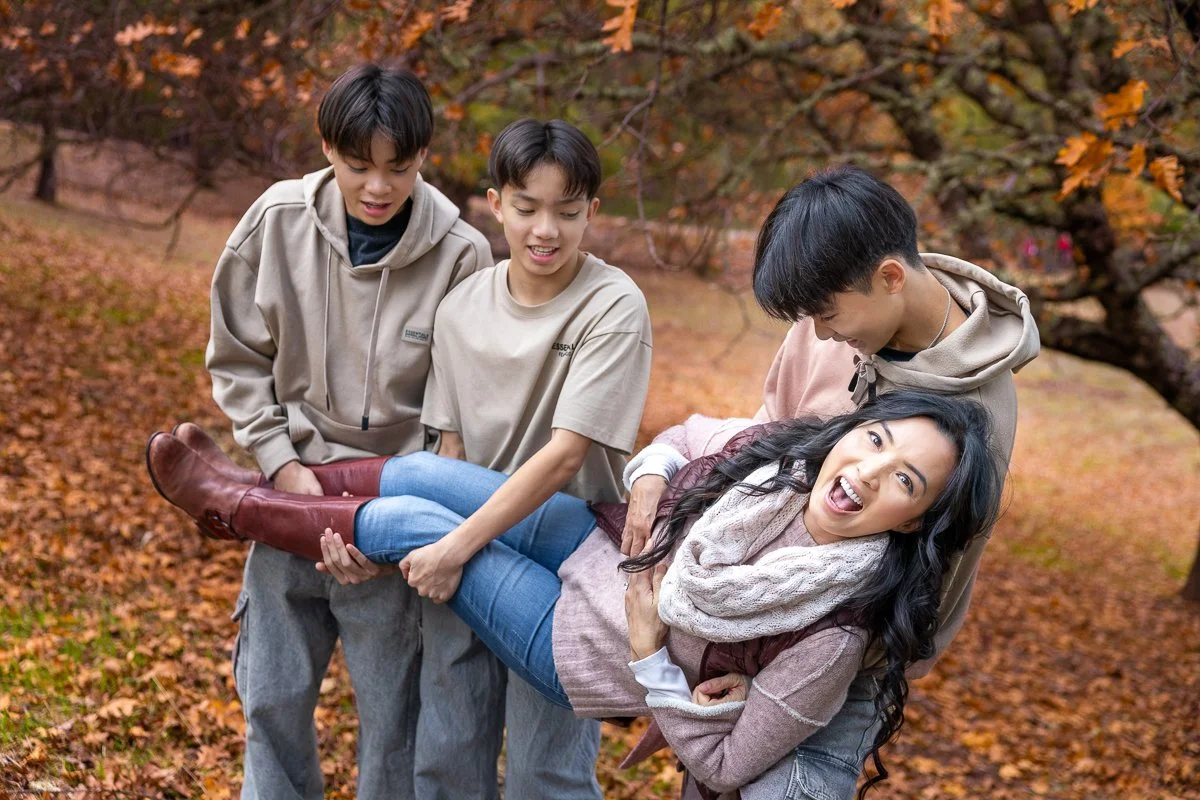
The boys planned this twenty seconds before I lifted the camera — none of it was my idea.
Choosing a location that works for your family
The instinct is to pick the prettiest place. The better question is which place actually fits your group.
A Pacifica bluff is gorgeous; it's also a half-mile walk on uneven sand and a long way back to the car if your two-year-old has a meltdown. Filoli is beautiful; it has rules about where you can and can't go and zero tolerance for off-trail wandering. Wilder Ranch is one of my favorite locations for extended families because it has parking next to the buildings, flat trails to the beach, real terrain for older kids, and historic farm structures that work as a backdrop without requiring a long walk.
The way I approach this is to start with the practical questions before we choose a location. How many people. How wide an age range. Anyone with mobility limitations. How much walking is realistic before the kids hit a wall. Does a dog come along. Is anyone bringing a stroller. Once those answers are clear, the right location usually picks itself.
For a deeper look at the locations I shoot most often and what each one is best for, see Best Bay Area Outdoor Photography Locations.
What to wear as a family
The version most photographers give you — neutrals, layers, no logos, complementary palette — is correct as far as it goes. It's also not specific to outdoor adventure sessions, where two factors change the equation.
First, you'll be moving. That means clothes that allow real movement, not stiff outfits that look great standing still and read as uncomfortable in motion. Second, the Bay Area weather is variable. A coastal bluff in May can be ten degrees colder than your car ride there. Layers stop being optional and start being necessary.
For the full breakdown including by-location and by-season notes, I have a separate post: What to Wear for an Outdoor Photo Session in the Bay Area. The short version is: dress like you would for a comfortable walk in the place we're going to.
The Bay Area weather conversation
This deserves more attention than most prep guides give it. The standard "book your session for fall" advice is too simple for the Bay Area. Fall has the most reliably dry weather, true, but our microclimate gives you usable conditions in seasons most photographers ignore.
Summer marine-layer mornings — the gray flat overcast that burns off around eleven — are some of the best light I shoot in. No harsh shadows, no squinting kids, no need to chase golden hour. A nine-thirty start at Pacifica or Half Moon Bay in July gives you cool temperatures, soft light, and a beach to yourselves. The session is comfortable and the photographs are clean.
Winter sessions are underrated. Between November and February, the rain comes in windows. You can usually find a clear morning within seven days of any planned shoot, and the low winter sun gives the entire day usable light — golden hour effectively starts at two in the afternoon and lasts until sunset. The trees are bare in some locations and green in others; the hills are at their most saturated green of the year.
The conditions I avoid for new families are mid-summer afternoons (high contrast, harsh light, hot, kids miserable) and the storm-window weeks of late January and early February when I'm rescheduling more than I'm shooting. Beyond that, every season works — it's just a question of matching the location to the conditions.
The practical commitment from me is that I monitor weather closely in the week before a session and reach out if anything looks wrong. I'd rather reschedule than push through a forecast I don't trust.
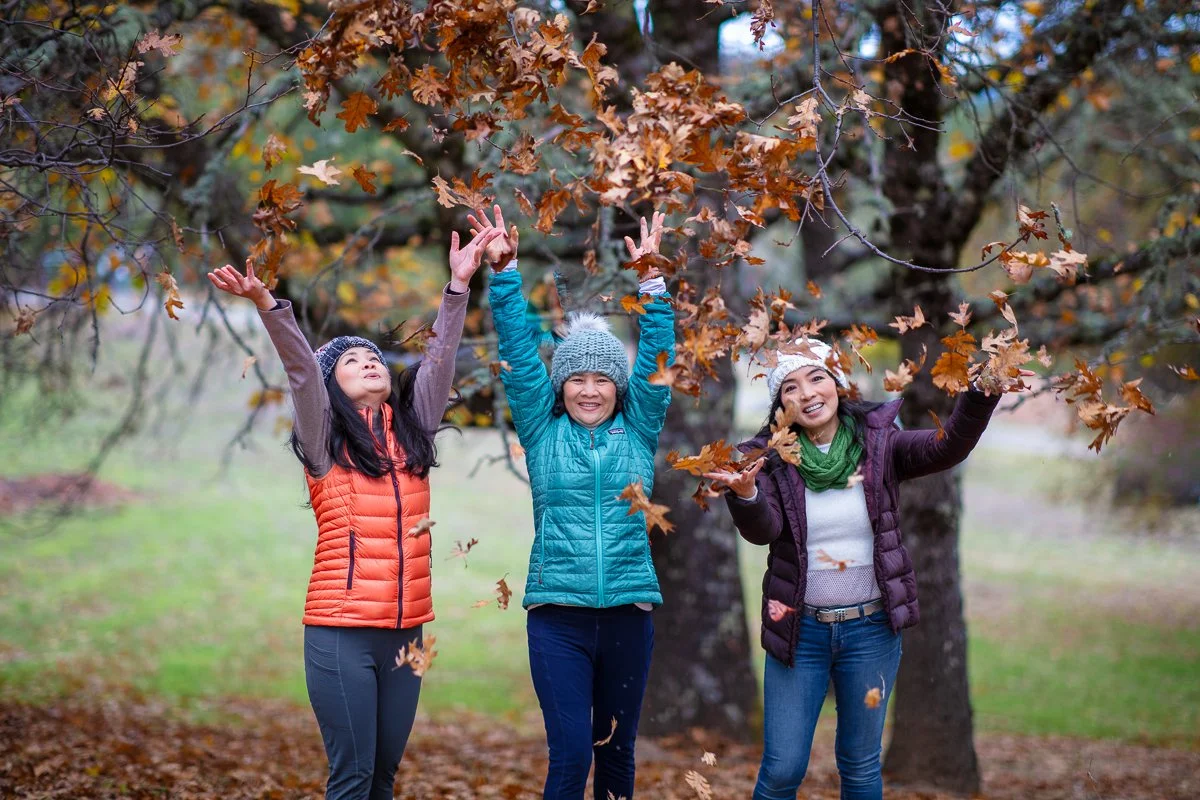
An overcast morning in the Bay Area — the kind of light most photographers won't shoot in and most parents don't realise is the best they're going to get.
Kids by age
The advice for a three-year-old and the advice for a fifteen-year-old are completely different, and most prep guides flatten them into one section. Here's how I think about it.
Toddlers and pre-schoolers (roughly two to five)
The two things that matter are timing and expectations.
Schedule the session for whichever time of day your child is reliably the best version of themselves — usually morning, after breakfast, before nap. Don't try to do family photos at four in the afternoon if four in the afternoon is when your kid melts down. The light is negotiable; their mood isn't.
The expectations piece is harder. Toddlers are not going to sit still or follow direction. The session is going to involve some amount of running, some amount of crying, possibly a snack, possibly a wardrobe change, and at least one photograph where someone's looking the wrong way. None of that is failure. The photographs you'll actually love at the end are the ones where your child was being themselves — reaching for a flower, looking up at a parent, twirling in a dress. Those happen when nobody is trying to make them happen.
I bring patience. You bring a snack and a backup outfit, and we trust that we have time.
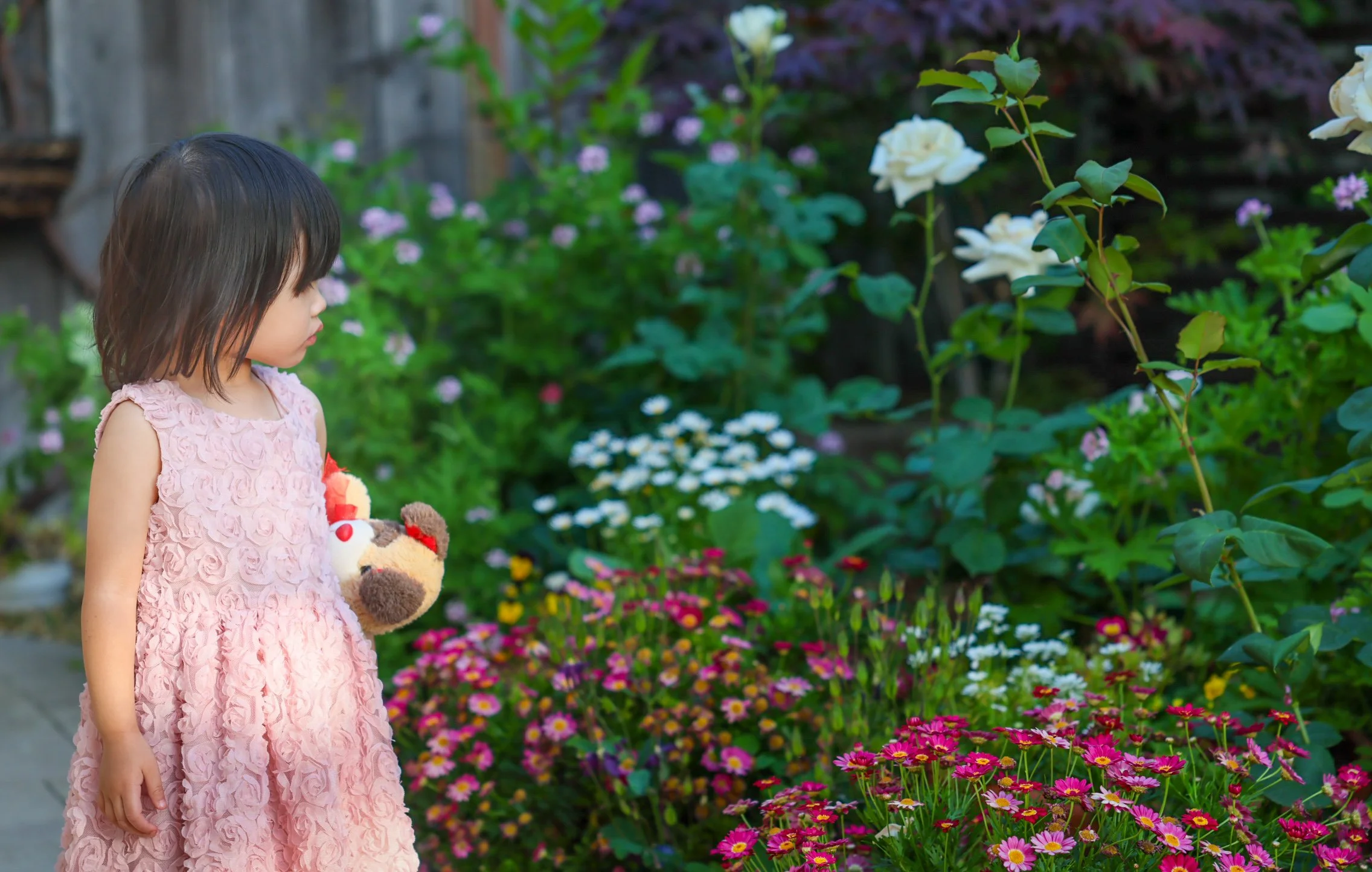
No instruction here. She walked over to the flowers and stopped, and I happened to already be in position.
School-age (roughly five to twelve)
Easier than toddlers in some ways and harder in others. They can follow direction, which means they can also do the thing that ruins family photographs: smile on command. The fake school-photo grin is the single biggest issue at this age, and the way to avoid it is to not photograph faces while a kid is performing. We walk, we explore, we look at things, we pick up sticks, we ask them about their day. The smiles you want come from real conversation, not from a camera prompt.
What I find at this age is that the kids who've been through other photo sessions sometimes need ten or fifteen minutes to unlearn the cheese-smile habit. That's normal. The session is paced so the first stretch is warmup and the strongest frames usually come in the second half.
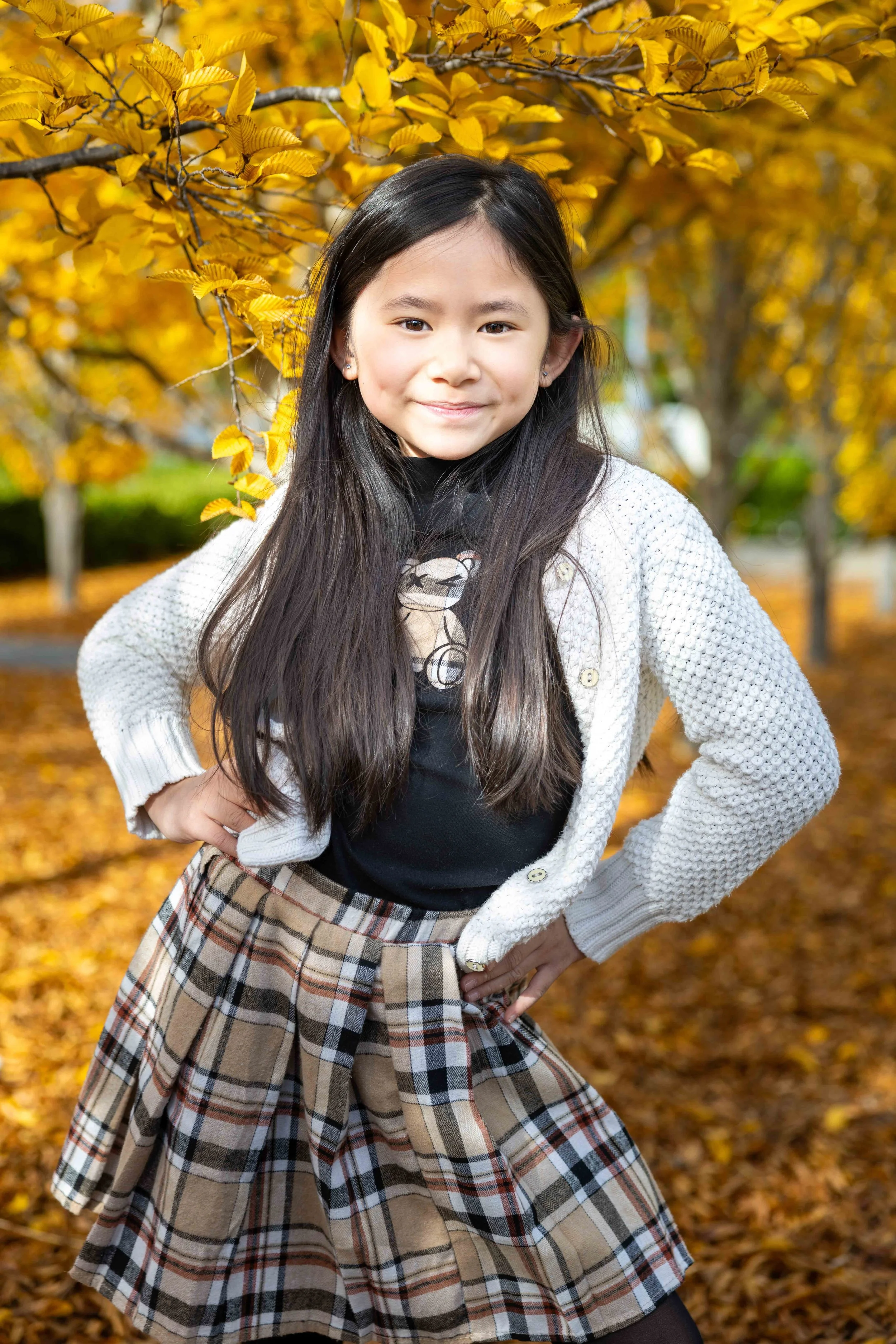
Asked her about her favorite class. The expression came two sentences into the answer.
Teens
The biggest fear parents have about photographing their teenagers is that the photos will look awkward, with sullen kids who clearly didn't want to be there. The fear is reasonable. Teenagers don't want to be there.
What I lean on is setting the session up so they don't have to pretend. We move. We do things they think are interesting. We don't ask them to smile. We let them stand in ways that feel like them, not ways their mother thinks look good. The photographs that result tend to be the ones parents are most surprised by — their teenager looking like the version of themselves they're actually becoming, calm and themselves, instead of forced.
If your teen really doesn't want to be photographed at all, I'd rather you tell me up front so we can plan around it. Fifteen good frames of a teen who's grudgingly cooperative beat an hour of fighting for cooperation that isn't there.
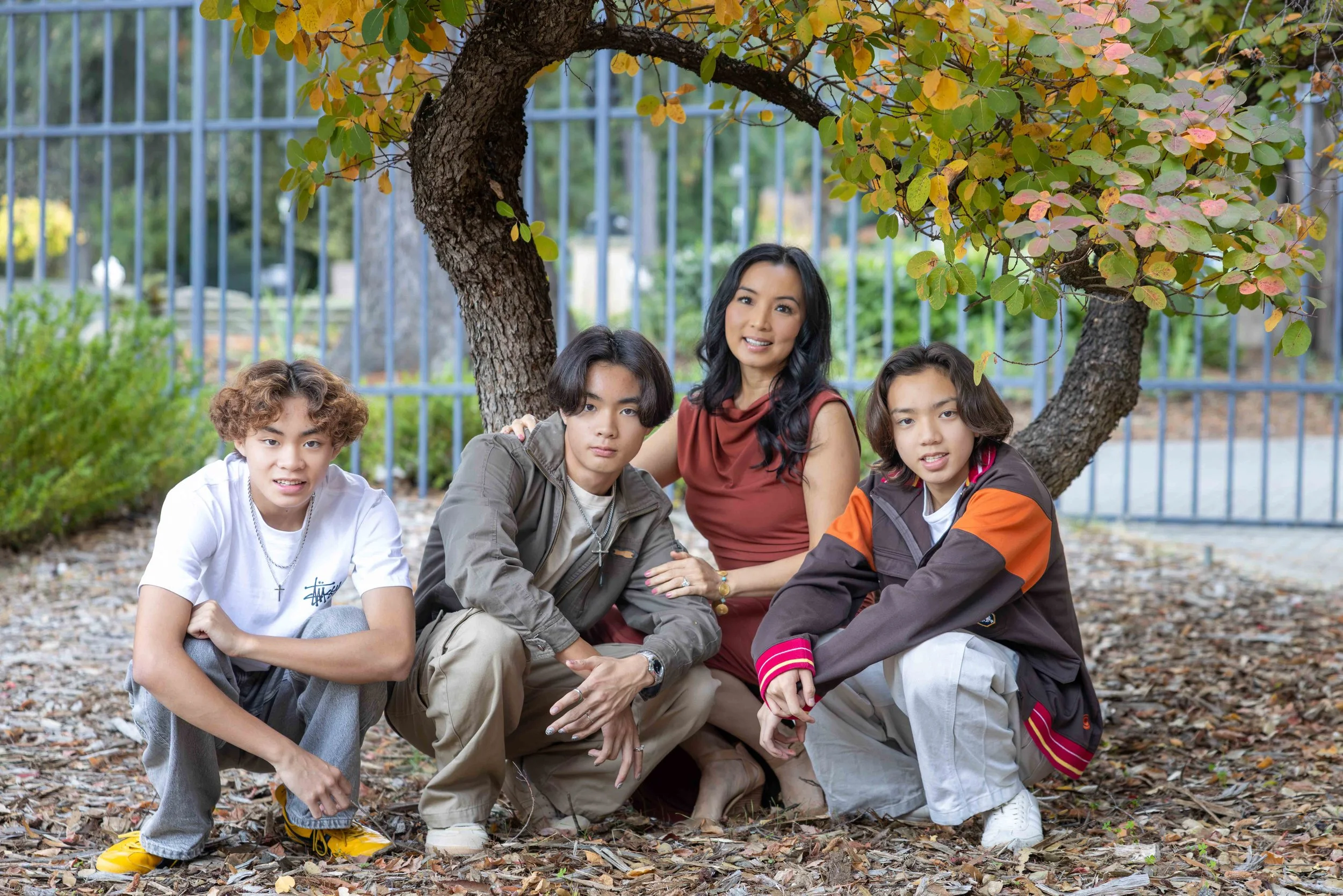
Three teenagers, in one place, all looking at the same camera. This was the second frame in the sequence.
Multi-generational sessions
The Peninsula has a lot of extended families. Cousins who grew up together, grandparents visiting from out of state, the get-together that happens once a year and never gets photographed properly. These are some of my favorite sessions to shoot, and they need a different prep conversation.
The biggest mistake I see is families trying to wrangle eleven people into a single posed group shot and considering that the goal of the session. The group shot matters — we'll get it — but it's one frame in an hour. The frames that families end up loving are the smaller arrangements: cousins together, grandparents with their grandchildren, the two adult sisters who haven't had a photograph taken together in fifteen years, the toddler being held by their grandfather.
Practically, this means three things. We pick a location with enough space and enough variety that we can do the group shot in one spot and break into smaller groupings nearby. We schedule for slightly longer than a standard session — extended-family work needs ninety minutes minimum, often two hours. And we talk in advance about which combinations matter most. If you tell me before the session that you want a frame of grandma with all six grandchildren, that's a frame I'll make sure we get.
Older relatives who don't walk well shape the location decision. Filoli, Gamble Garden, the San Jose Rose Garden, and the flat sections of Wilder Ranch all work for groups that include someone who can't manage a long walk. We meet near the parking, work the area within a short distance, and let everyone else explore further only if they want to.
For a sense of how a multi-generational outdoor session actually flows, see my recent Wilder Ranch family session — three generations, multiple kids of varying ages, a working ranch as the location.
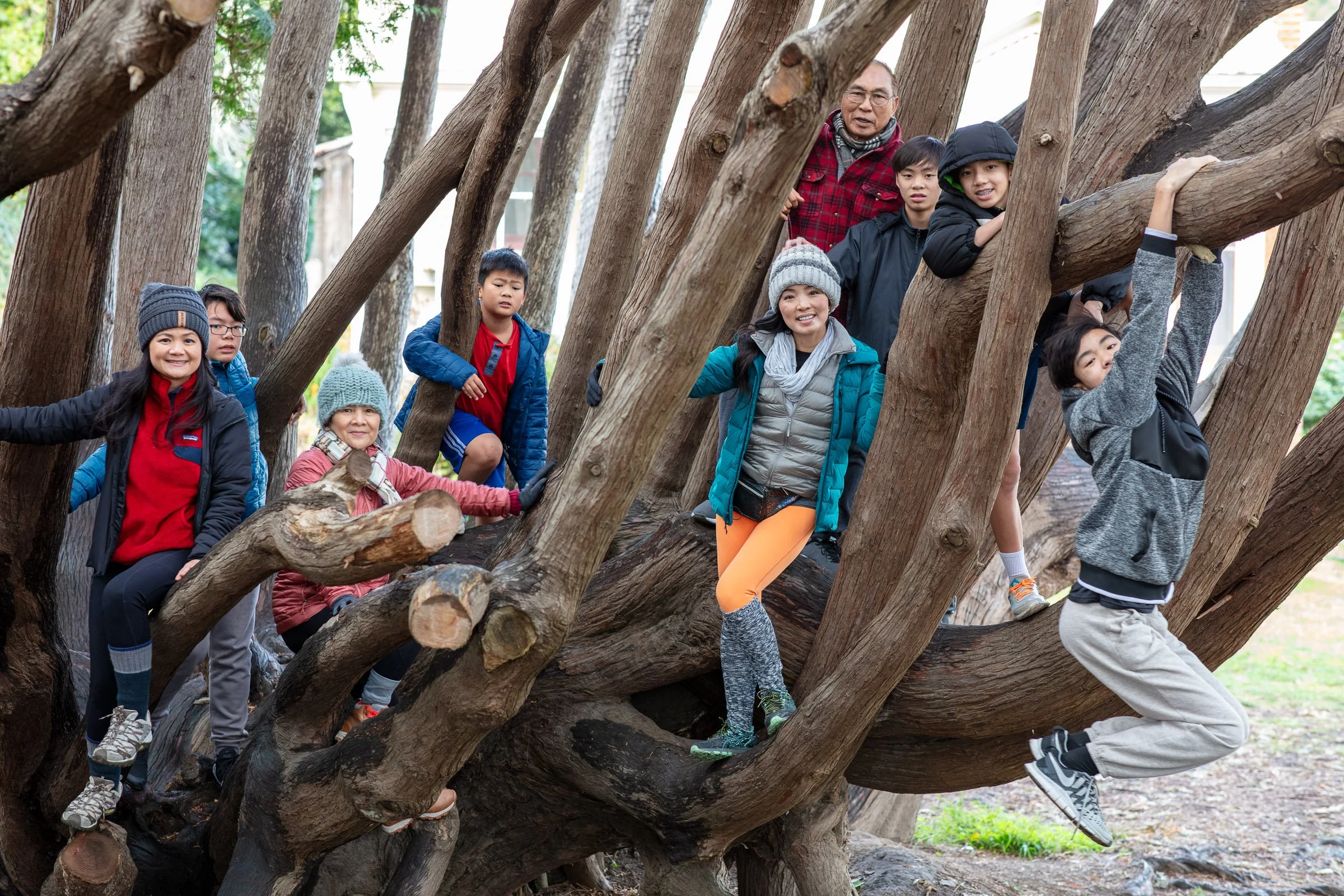
No one in this photograph stood where I told them to stand. The location asked for it; they responded.
Bringing the dog
Dogs are welcome at most outdoor sessions. The locations I shoot at vary on dog policies — Filoli is no, Wilder Ranch is yes on leash, Tomales Point is no, most coastal trails are yes — and that should factor into location choice if your dog is part of the photographs.
The setup that works in practice: a second adult comes along to manage the leash, treats, and water. The dog wears a neutral-coloured leash and harness, not a bright nylon one. We let the dog off-leash for photographs only where it's allowed and only if you're confident your dog will stay close. The treats live with the leash-handler, not with the kids, so they don't become a distraction during the shots that don't involve the dog.
Plan for the dog to need ten minutes to settle into the location before they're useful in front of the camera. The first part of the session usually goes better if the dog has had a chance to sniff around and burn off the excitement of being somewhere new.
For the partner who'd rather not be photographed
Almost every family I shoot for has someone in this category. Usually it's the dad, sometimes it's a teenager, occasionally it's the mother who arranged the session in the first place and has been dreading it ever since. The dynamic is real and I've thought a lot about how to handle it.
The first principle is that we don't argue about it in front of the camera. If your husband doesn't want to be told to smile, telling him to smile harder will not help. The session is set up to give camera-shy people the easiest possible version of being photographed: we walk, we move, we have actual conversations, and I photograph the moments where they've forgotten the camera is there. Those moments come, reliably, in the first fifteen to twenty minutes of any session — once people stop watching themselves.
The second principle is that you, the person who arranged the session, don't try to manage the camera-shy person's experience during the shoot. Trust them to settle in. Don't apologize on their behalf, don't keep checking on them, don't ask if they're having a good time. Their job during the session is to be present with the family, not to perform happiness for either you or me.
The photographs that result usually surprise the camera-shy person more than anyone else. They go in expecting to look stiff, and they end up looking like themselves — engaged with their kids, present with their partner, comfortable. The before-and-after on this is one of my favourite parts of this work.
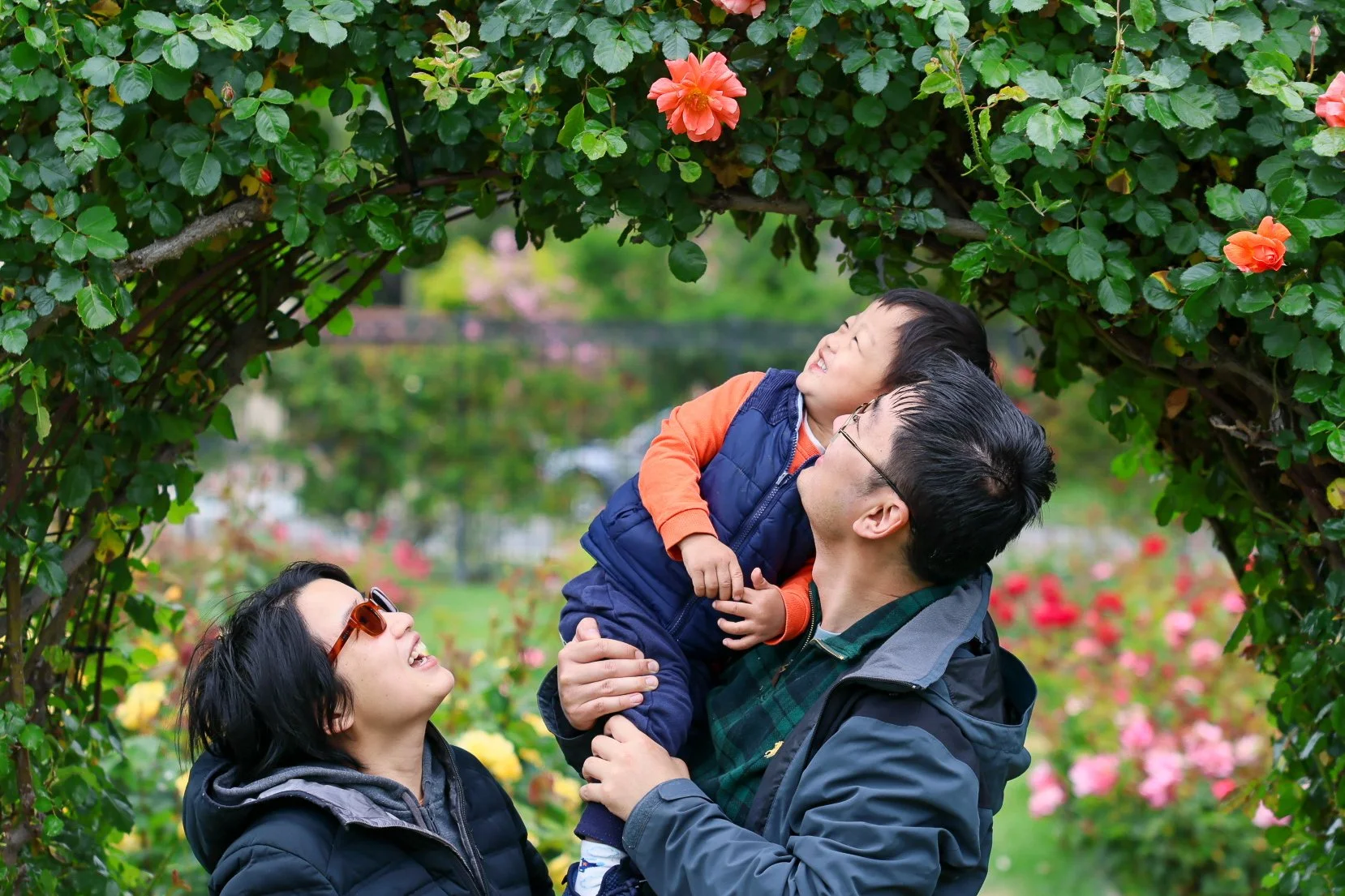
Twenty minutes earlier the dad told me he wasn't sure about being in the photographs. He forgot.
What to bring
Less than you think.
Snacks for the kids. Water for everyone. A backup outfit for any toddler who might have a wardrobe accident. A small bag for phones and wallets so they're not in pockets during photographs. If a dog comes, treats and waste bags. If you have a specific keepsake you want included — a quilt, a stuffed animal, something passed down — bring it and tell me about it before the shoot, not during.
What I'd skip: bulky props, balloons, anything glittery (against Leave No Trace), large signs, professional outfits that don't allow movement, and a pre-written shot list of more than three or four must-have images.
What I bring: gear, water, a few extra reflectors, a small first-aid kit, and patience. The session is paced for whoever needs it to be — if a toddler needs a break, we take a break. If grandma needs to sit, we sit.
A note on planning
Most of the prep work for an outdoor family session in the Bay Area happens in the conversation we have before the shoot. Once you've answered a few practical questions — who's coming, what they can handle, what photographs matter most to you, when we should shoot, where we should go — the day of the session is mostly about showing up and letting it unfold.
Outdoor adventure family sessions don't need more preparation than studio sessions. They need different preparation. The above is the version I actually want families thinking about.
If you'd like to talk through a session for your family, get in touch here. Sessions on the Peninsula and across the Bay Area; outdoor only.