
Stanford Cactus Garden Photography: A Bay Area Location Guide
A Hundred-Year Garden Most Photographers Walk Past
The Stanford Cactus Garden doesn't appear on most Bay Area photography location lists. From the outside it doesn't look like much — a low wall, some signage, an entrance that suggests something functional rather than beautiful.
Inside is different.
Officially called the Arizona Cactus Garden, it's one of the oldest cactus collections on the West Coast — planted in the 1880s as part of the original Stanford estate, and continually expanded since. The garden now holds hundreds of species of cactus, agave, and succulents, including crested specimens that have been growing in place for over a century. Several of the larger barrel cacti and columnar specimens predate most of the surrounding campus.
The garden is free, public, and requires no permit for personal portrait work. That alone makes it unusual on the Peninsula — most location-grade photography venues at this scale require either an admission fee, advance booking, or both. The Cactus Garden requires none of it. You can walk in at 6:30 in the morning and have an hour of empty paths and good light entirely to yourself.
If you're researching it for a session — your own, or one you're booking — this is what's actually worth knowing.
When to Shoot: Time of Day
The garden works in two distinct light windows, and they produce completely different sessions.
Early morning, 7–9am. Light comes in low and east-facing across the garden, raking through the columnar cacti and lighting the silvery agaves from the side. Shadows are long. Detail in the spines and ribs of the larger specimens is at its strongest. This is the window for editorial work — sharp, contrasty, graphic — and it's when the garden is genuinely empty. On a weekday in spring, I've had the place to myself until well past 9.
Golden hour to sunset. The opposite light. The sun drops behind the western edge of campus and the garden falls into shaded but luminous open shade, with the surrounding dry grass and the western perimeter catching the last directional warmth. This is the window for softer, more romantic work — and it's when the dry grass at the perimeter becomes the most photographically interesting feature of the entire site.
What to avoid. Mid-day sun, particularly summer mid-day. The cacti throw harsh black shadows onto themselves, the concrete paths become a glare problem, and there's no canopy anywhere in the garden to soften it. Between roughly 11am and 3pm in summer, the location is essentially unusable for portrait work.
What Blooms, and When
Different parts of the garden are at peak in different months. Knowing the calendar matters because the bloom windows are narrow and they don't always repeat the same way each year.
Late spring (May–June): Prickly pear. Yellow, pink, and orange flowers scattered across the flat paddle surfaces. The window is short — sometimes only two or three weeks — and it doesn't show up on any official calendar, so timing it is partly luck. If you find the prickly pear in flower, work fast. The color pulls strongly into portraits, particularly against yellow or warm-toned wardrobe.
Late spring (May–June): Smaller cacti. Many of the smaller barrel cacti and clumping species push out brief, vivid blooms at the same time as the prickly pear. They photograph well as foreground or background detail.
Winter (December–February): Aloes. The red aloe section, near the southern edge of the garden, sends up tall flowering spikes in deep red — sharp, almost graphic, the kind of color that photographs as editorial rather than natural. This is one of the strongest single backdrops in the garden and it's only available for a few weeks each winter.
Rare, spectacular: Agave bloom. Agaves flower only once in their lifetime — sometimes after twenty or thirty years — and then die back. When one of the older agaves flowers, it sends up a stalk fifteen or twenty feet tall that lasts for several weeks. Worth checking each spring.
Summer through fall (August–November): The dry grass. Not a flower, but the perimeter grass turning gold and brittle is arguably the most useful seasonal feature of the entire site. More on this below.
The Dry Grass — Best Light of the Day
The dry California grass at the garden's perimeter and along the path approaches is the location's most underused asset. Most photographers come for the cacti and don't look at it. By late summer and early fall it stands knee-high, pale gold, and entirely dry — and at the right time of day it produces the warmest, most cinematic light available anywhere on the site.
Sunset is when it's at its best. In the last thirty minutes before the sun drops behind the western buildings, the grass catches direct golden-hour light from a low angle and behaves almost like a softbox in reverse — the stems themselves glow, the spaces between them go honey-warm, and a subject standing or sitting in it picks up reflected light from below.
Late August through October is the strongest seasonal window. By November the first rains start flattening the grass; by January it's green again and looks ordinary. The narrow window of August–October at sunset is where this corner of the garden does its best work.
If you want one strong editorial frame from this location, this is where to chase it.
The Art Around It
The Cactus Garden sits on the Stanford campus within walking distance of several outdoor sculpture installations worth knowing about for longer sessions. The most photographically interesting is Andy Goldsworthy's "Stone River" — a 320-foot serpentine line of sandstone partially embedded in the ground, made from stone salvaged from buildings damaged in the 1906 earthquake. It's a few minutes' walk and runs along open lawn near the Cantor Arts Center. It photographs as a graphic line through the landscape and pairs unexpectedly well with editorial portraits.
For a longer session, building a route between the Cactus Garden, Stone River, and the Cantor Arts Center exterior (corten steel sculptures, sandstone walls) gives you three distinct visual environments within walking distance, and a half-day session that doesn't repeat itself.
Parking, Access, and Crowds
Parking on weekends is free across most Stanford lots. The closest to the Cactus Garden are the Roth Way Garage and the Cantor Arts Center parking lot — both a three-to-five-minute walk.
Weekday parking requires a paid permit through the Stanford ParkMobile system. Expect roughly $14–20 for a half day. Worth factoring into the session cost calculation, particularly for weekday morning shoots when the light is at its best.
Access to the garden itself is unrestricted. No permit required for personal portrait work. Commercial shoots may require permission from Stanford — worth checking if the project is paid editorial or advertising.
Crowds. The garden is genuinely quiet on weekday mornings. Weekends and afternoons are busier — but the heaviest period is the holiday-card season, late October through December, when local families flood the garden on weekend mornings for Christmas-card portraits. If your session is in November or December, shoot on a weekday. If it has to be a weekend, get there at opening light and plan to be done before 10am. The garden can shift from empty to crowded in under thirty minutes on a December Saturday.
What the Garden Looks Like, Working
The frames below come from a personal lifestyle session in mid-spring, on an overcast morning that opened up the shadow detail in the cacti and gave the whole garden a softer, more painterly register than it has under direct sun. We'd spent the morning at the Stanford Cantor Arts Center and walked over to the Cactus Garden as the light shifted.
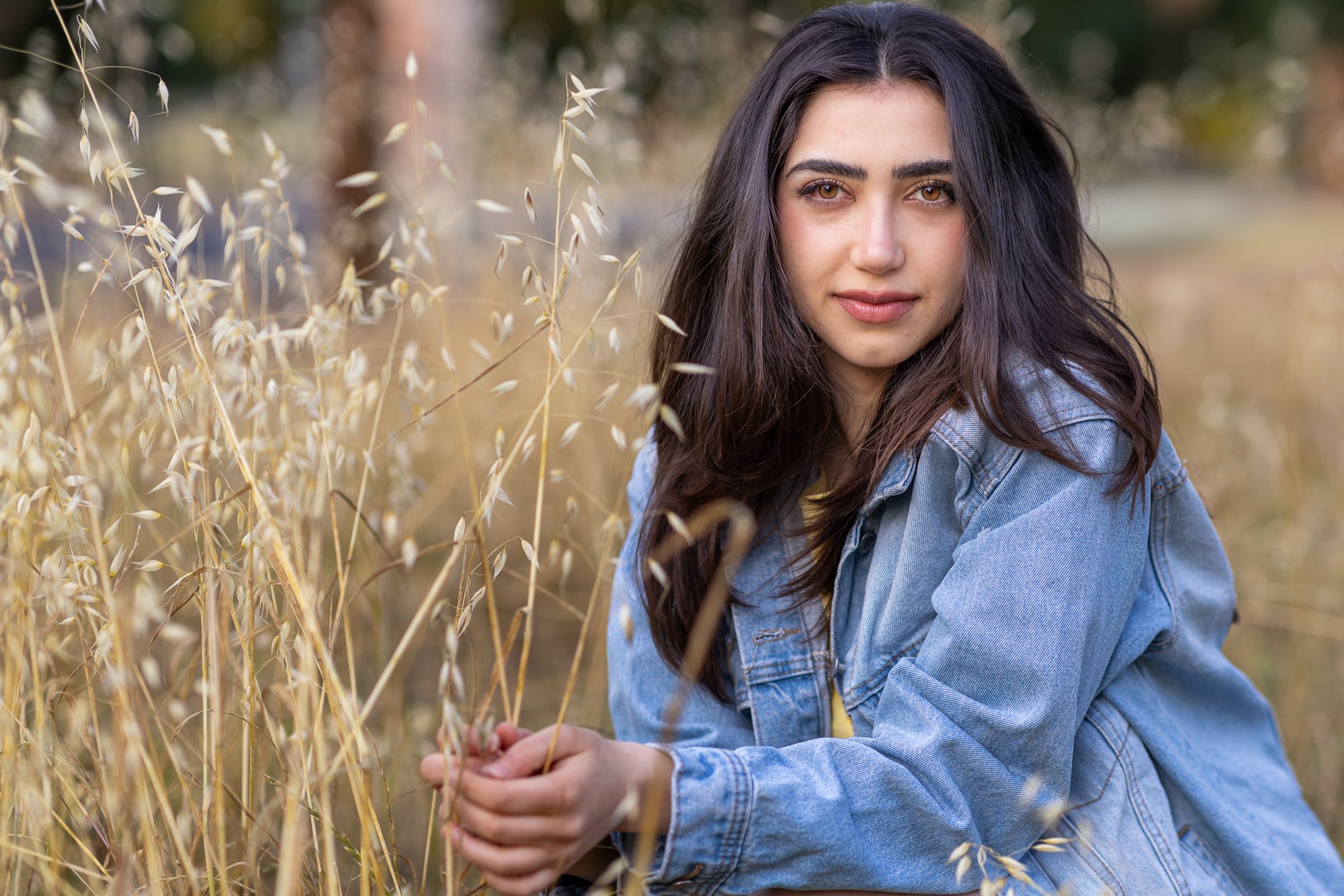
The grass most photographers walk past on the way to the cacti.
We started at the garden entrance with the pale gold California grass standing knee-high along the path. The overcast light through it was turning each stem warm, with the background blurring to amber.
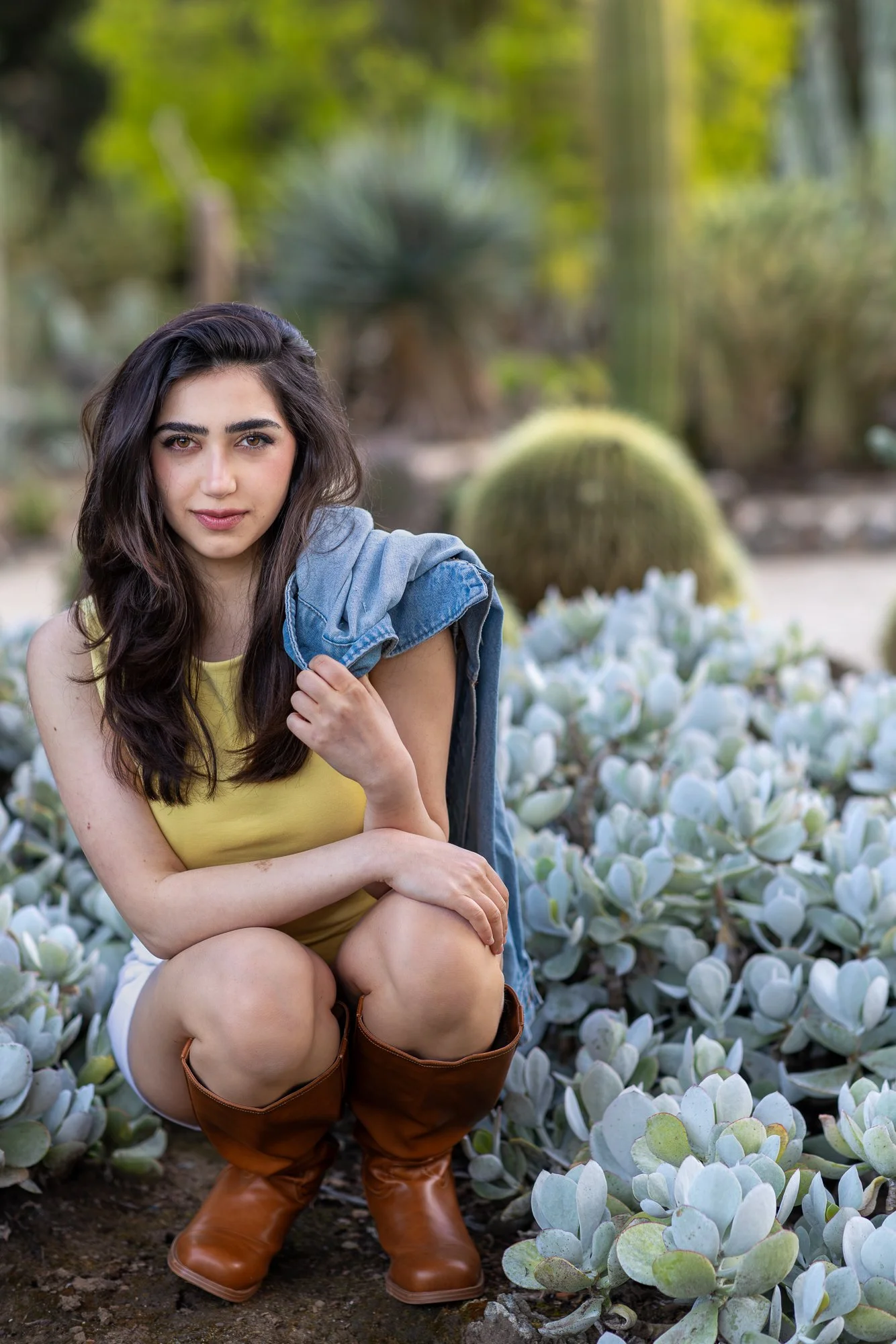
The cacti become the supporting act in a beautiful photo.
The succulent section came next — a low-growing silver-blue variety spreading in dense clusters, creating natural foreground and midground without competing with the subject.
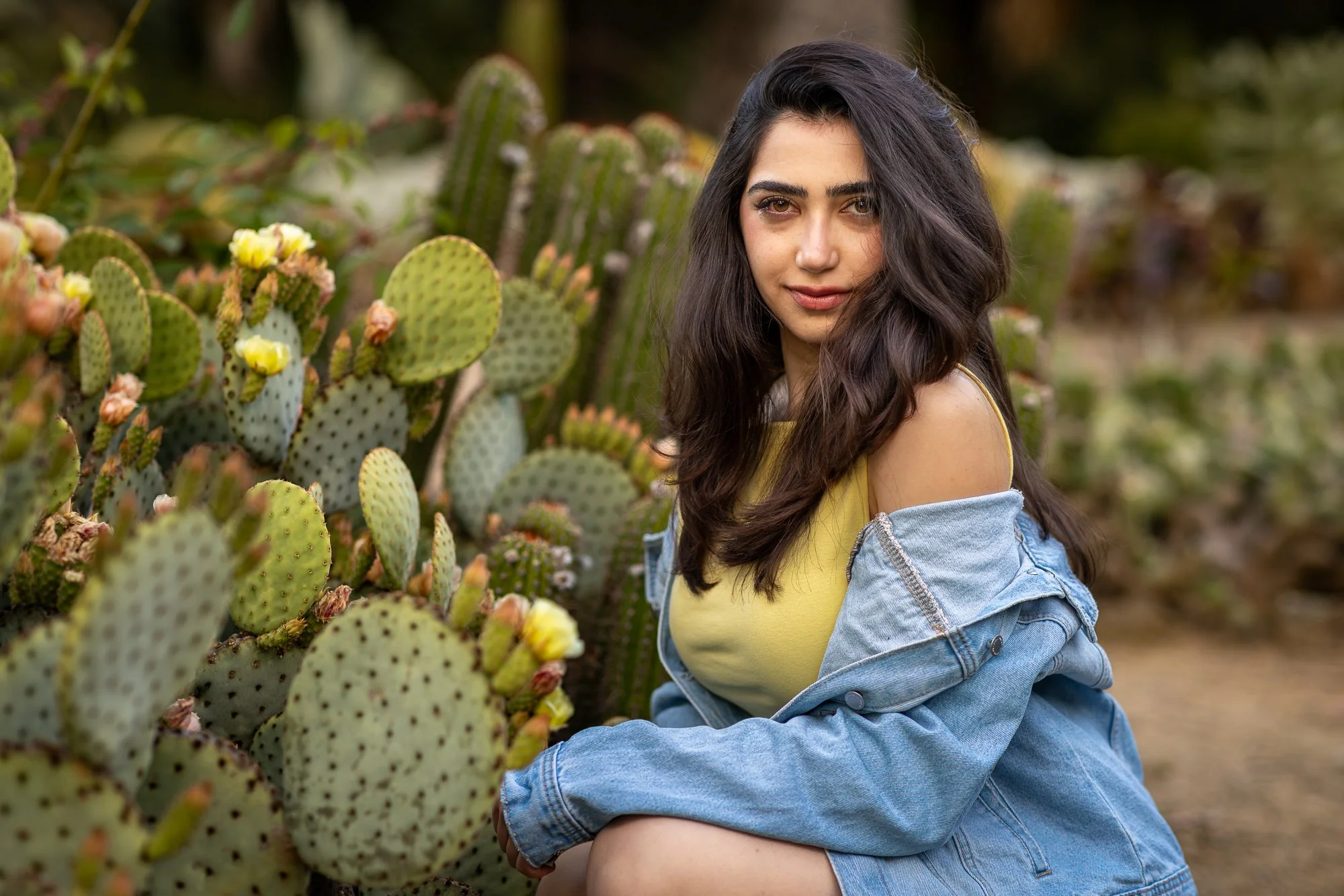
The jacket shifted off one shoulder and changed the whole image.
The prickly pear was at peak bloom — yellow and pink scattered across the paddles. The color relationship with her yellow top was something I couldn't have engineered, and the window for prickly pear flowers is short. We worked it for as long as the light held.
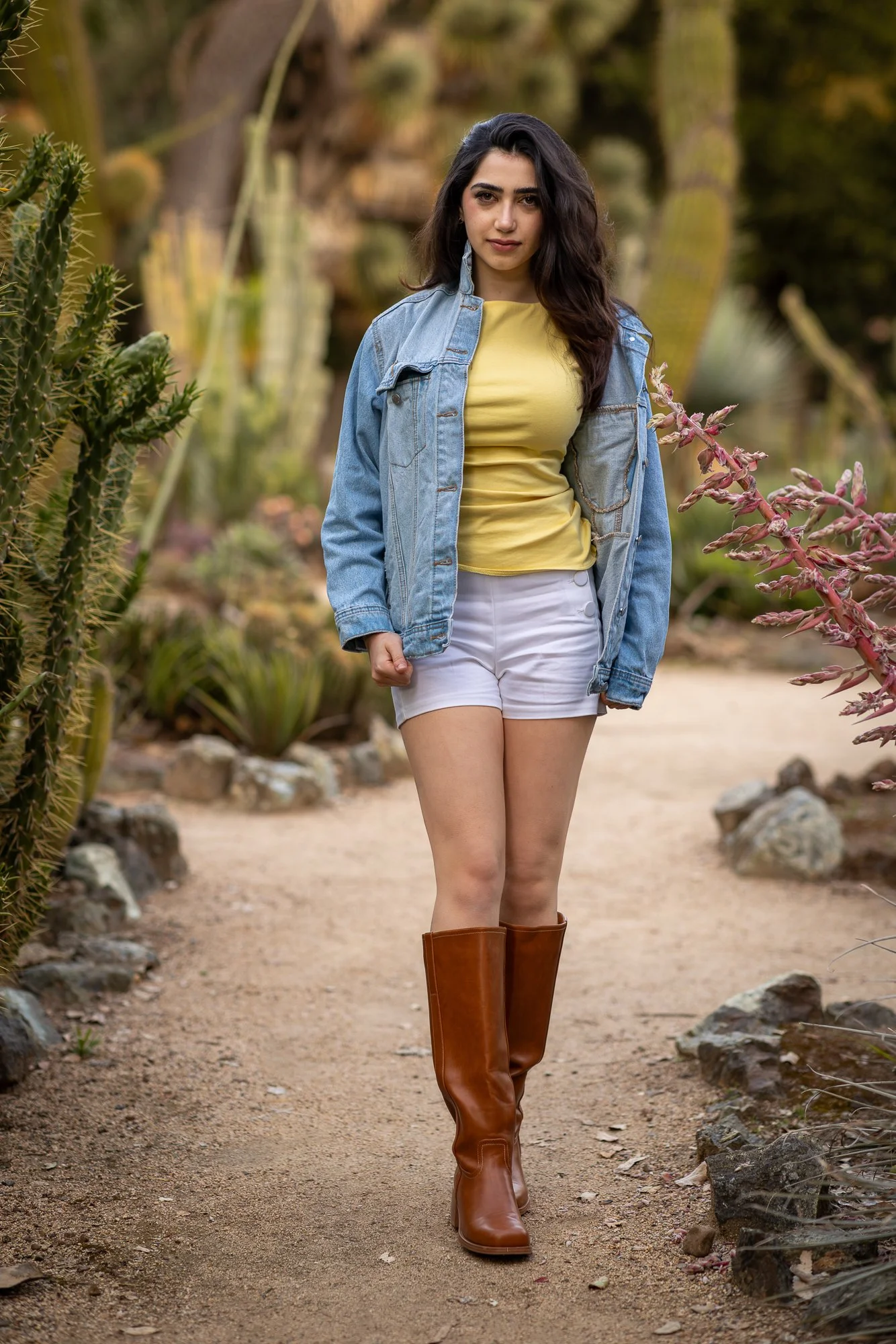
The path does the compositional work — the cacti receding into blur on both sides.
The curved path through the columnar cacti gives you a corridor that does the compositional work without you having to create it.
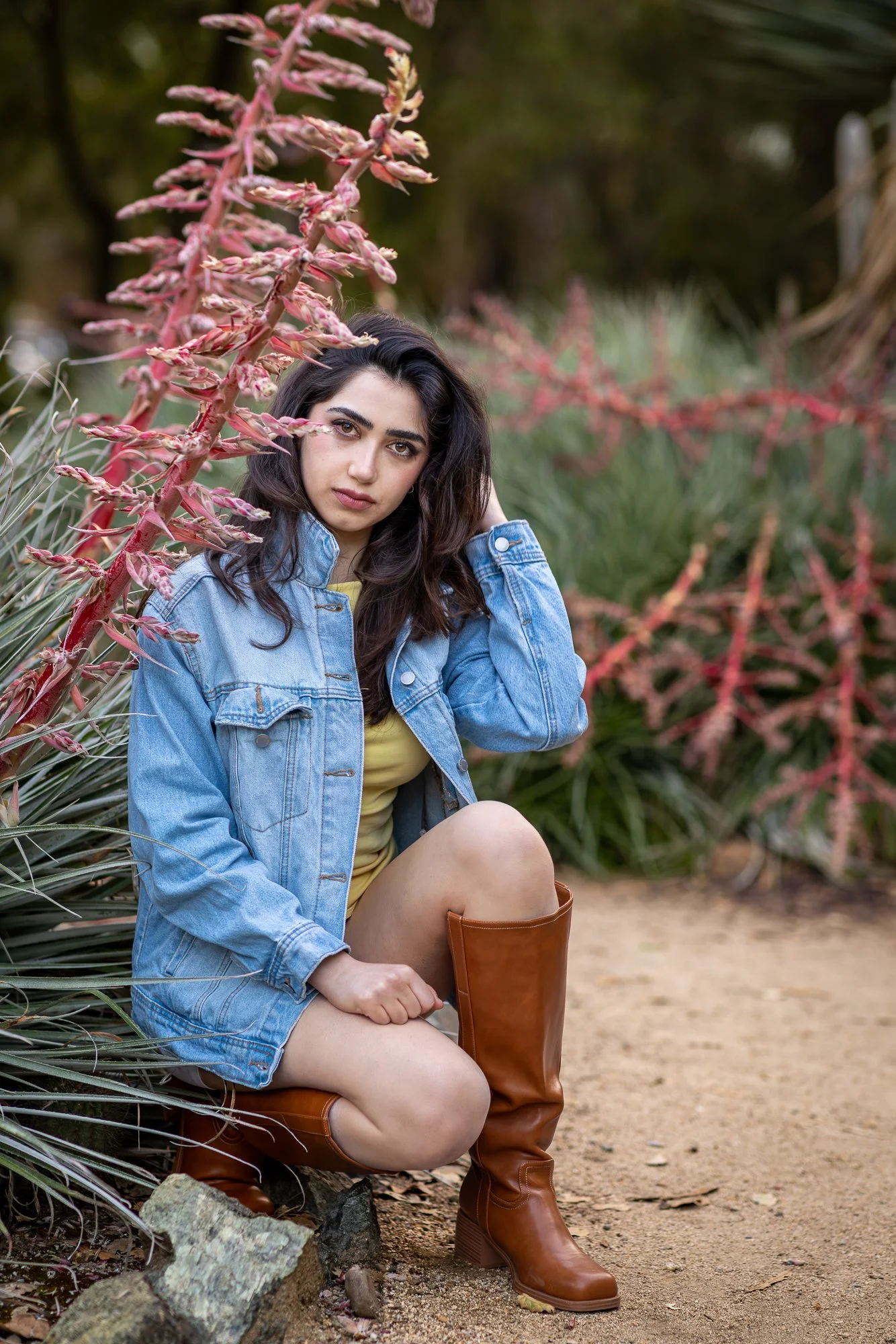
The aloe is where the session shifted register. Some backdrops do that.
The red aloe was in late bloom — sharp graphic spikes rising above and behind the frame. This is where the session shifted register from natural to editorial.
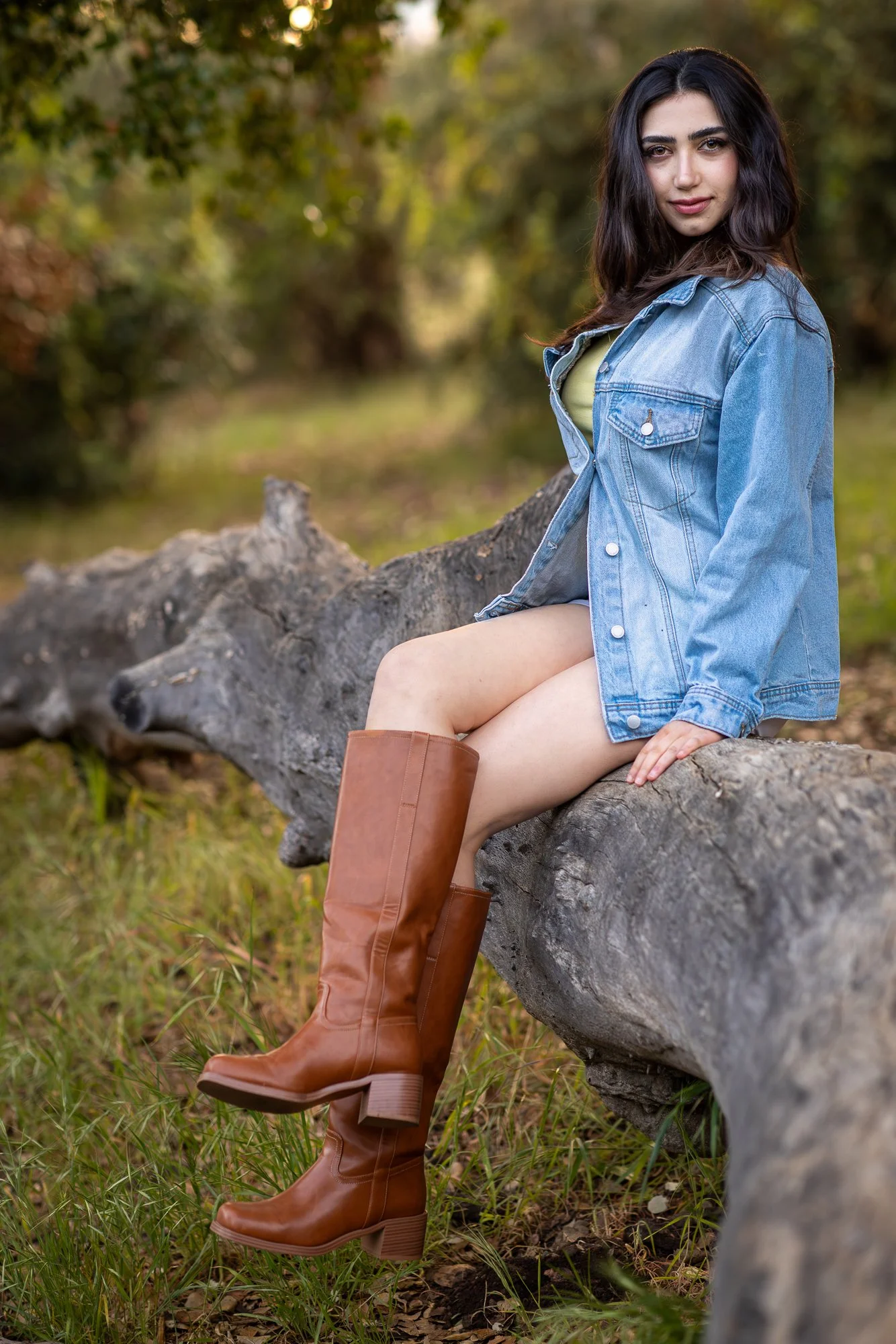
Unplanned stop. The best light of the whole day was landing on a fallen log.
A fallen log near the garden boundary — unplanned, found on the way out. The canopy created a soft tunnel of warm green light. By this point in the session she'd stopped thinking about being photographed.
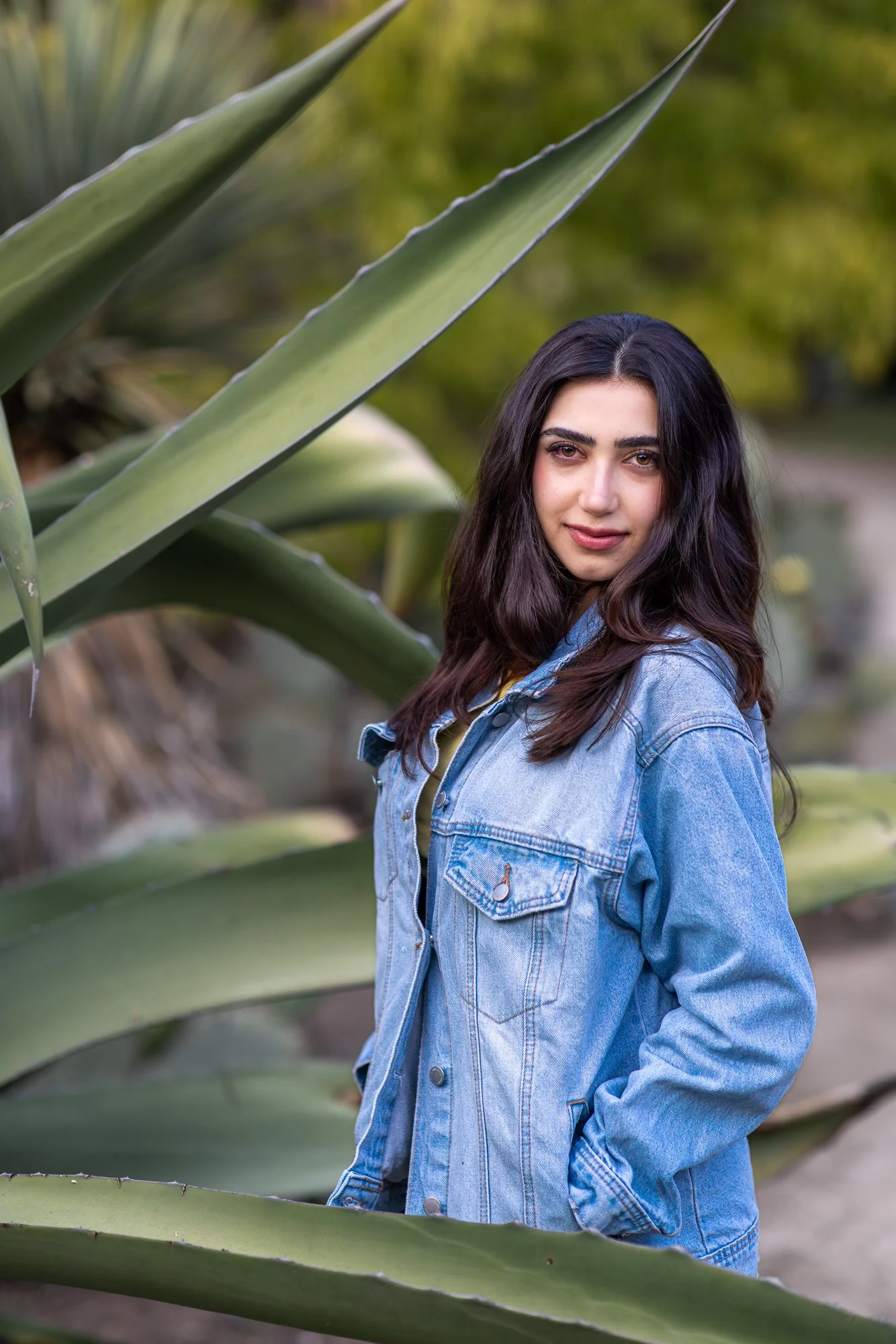
Nothing else in the garden has that scale. The right note to finish on.
We finished in the agave. A single massive plant near the entrance, leaves spanning two meters in every direction. Tight on her face, soft green bokeh behind, the geometry of the agave framing everything.
Worth the Walk
The Stanford Cactus Garden rewards familiarity. You need to have walked it a few times — at different hours, in different seasons — to know where the light lands and which specimens create the right backdrop on a given morning. It looks unremarkable from the outside. It reveals itself slowly. That's exactly the kind of place worth knowing as a Bay Area photographer.
For a full guide to locations across the Peninsula and beyond, see my Best Bay Area Outdoor Photography Locations guide. If you're interested in a personal lifestyle session, get in touch here.