
Eight Days on the O Circuit: What It Looks Like to Bring a Photographer to Patagonia
Torres del Paine National Park, Chilean Patagonia
When someone asks what I do, I say I'm an adventure photographer. What I mean by that is something more specific: I go where my clients go, I carry what they carry, and I photograph what actually happens — not a version of it staged for a camera.
The O Circuit at Torres del Paine is one of the most extreme tests of that idea I've encountered. Eight days. Roughly 130 kilometers. Lenga beech forests, glacial rivers, open pampa, two major passes, and a glacier so large it takes several minutes to sweep your eyes across it. I documented all of it — the hard parts and the spectacular ones, the weather, the mud, the exhaustion, and the moments that stop you mid-step and make you forget every ache you've been carrying.
This post is about what it looks like when a photographer joins you on a multi-day expedition trek. If you're planning the O Circuit yourself, I also wrote a detailed tips and logistics guide — you can read that here.
Day One: Into the Lenga Beech
The circuit starts gently — and deceptively. After the park entrance and the first ridge climb out of Refugio Seron, the trail drops into lenga beech forest and you begin to understand what you've signed up for.
Lenga beech is unlike any tree I've photographed. The bark is silver-grey and lichen-draped, almost architectural. In autumn the leaves are beginning to turn. In places the trail narrows to a single track between the trunks, roots threading across the path at ankle height, and you have to give full attention to every step.
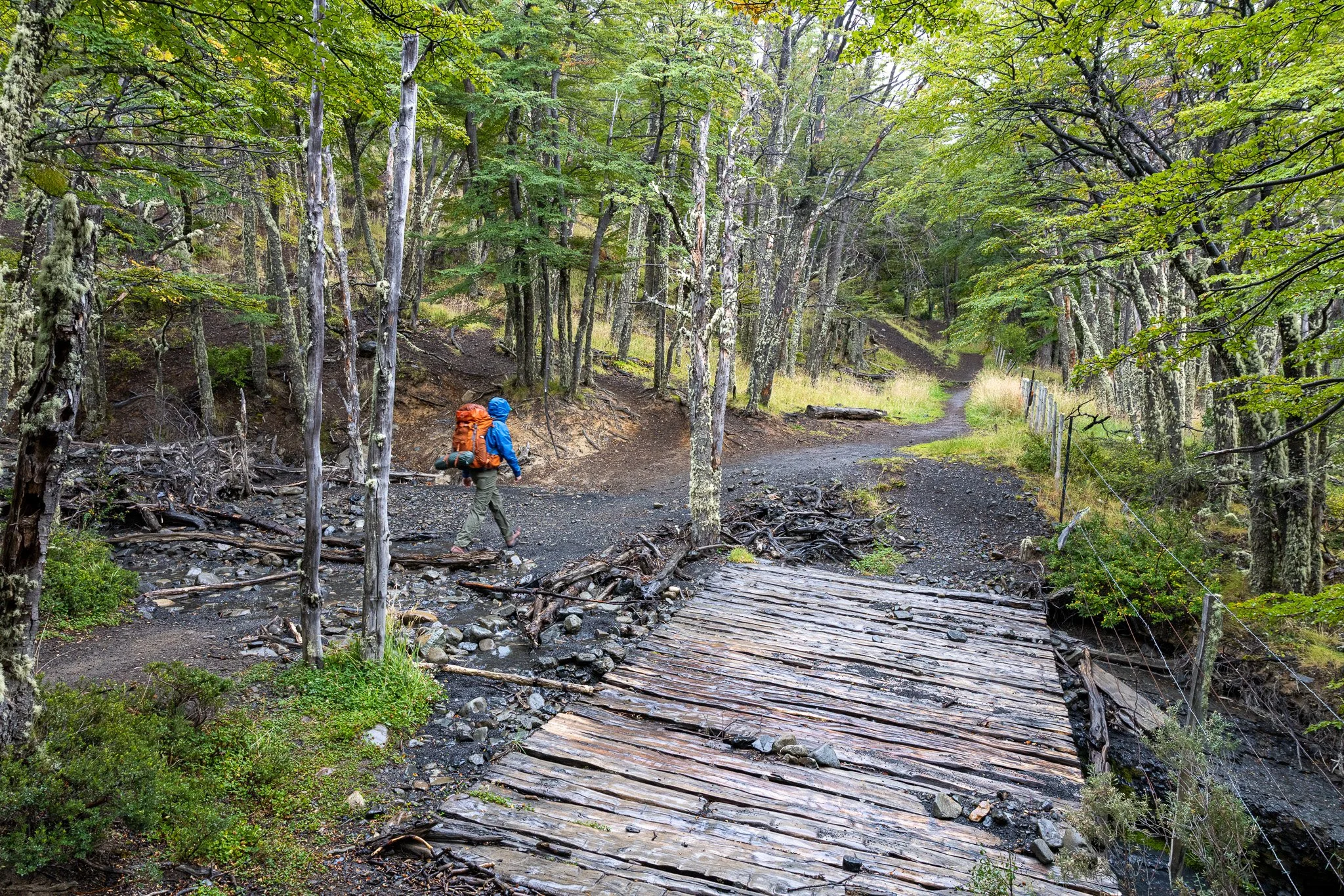
Into the lenga beech — day one sets the tone. The forest is quiet and the trail is all yours.
From a photography standpoint, this is where I establish the visual language for the whole trip. I'm looking for the relationship between the human figure and the landscape — not posed portraits, but the real shape of someone moving purposefully through a place. The orange pack against silver bark. The trail curving and pulling the eye forward.
The northern circuit opens up as you gain elevation above the treeline. The Seron valley stretches wide below, the Rio Paine snaking through golden grass, snow-capped mountains closing the far end of the frame. The scale becomes real very quickly.
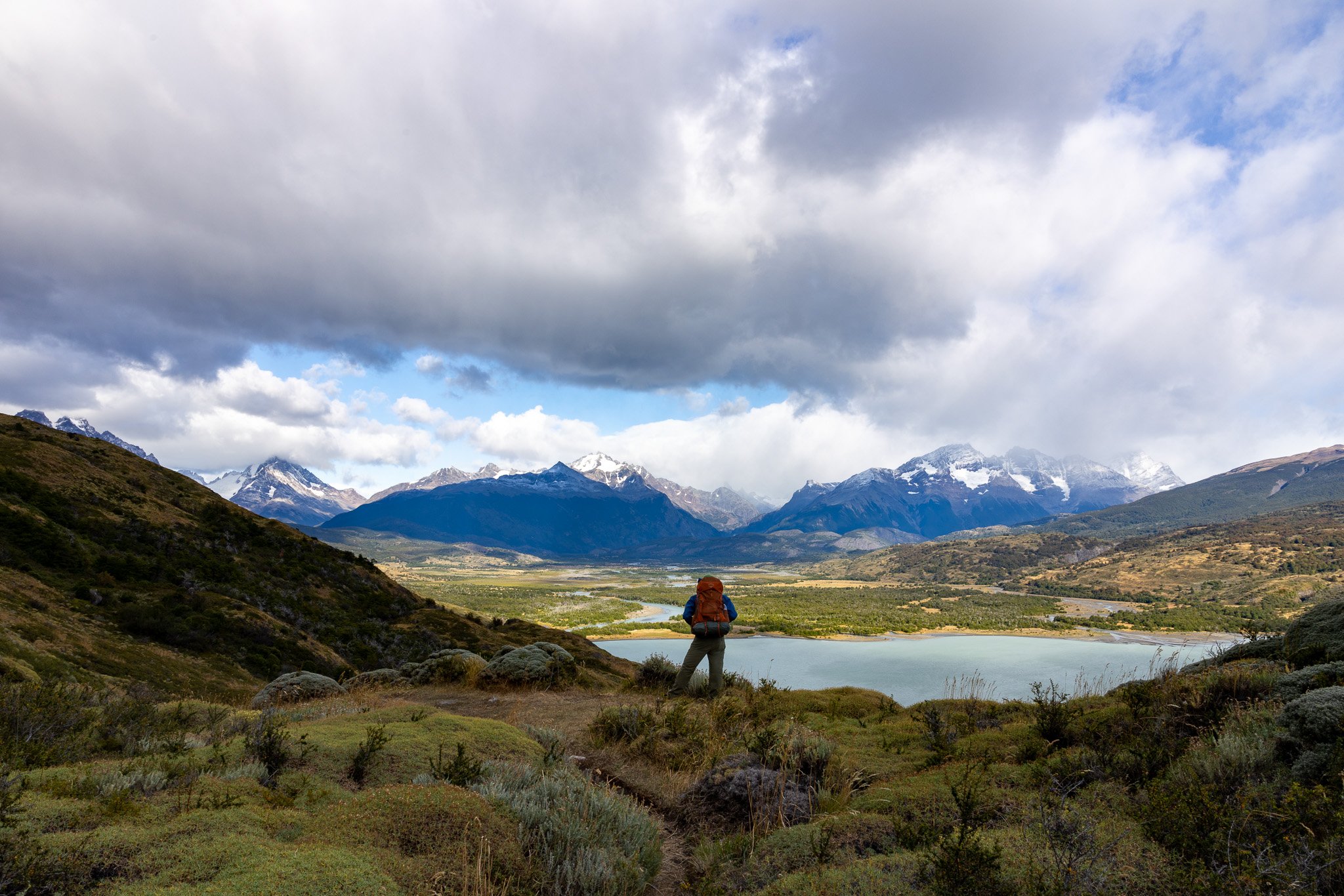
Looking back toward Seron on day one — the northern circuit is quieter and rawer than the W Trek, and this is where that solitude begins.
The second morning in Dickson delivered one of the unexpected gifts of the trip. I work up early, grabbed the camera and walked to the water's edge. The pink and orange light hitting the peaks above the lake is the kind of thing you don't plan for.
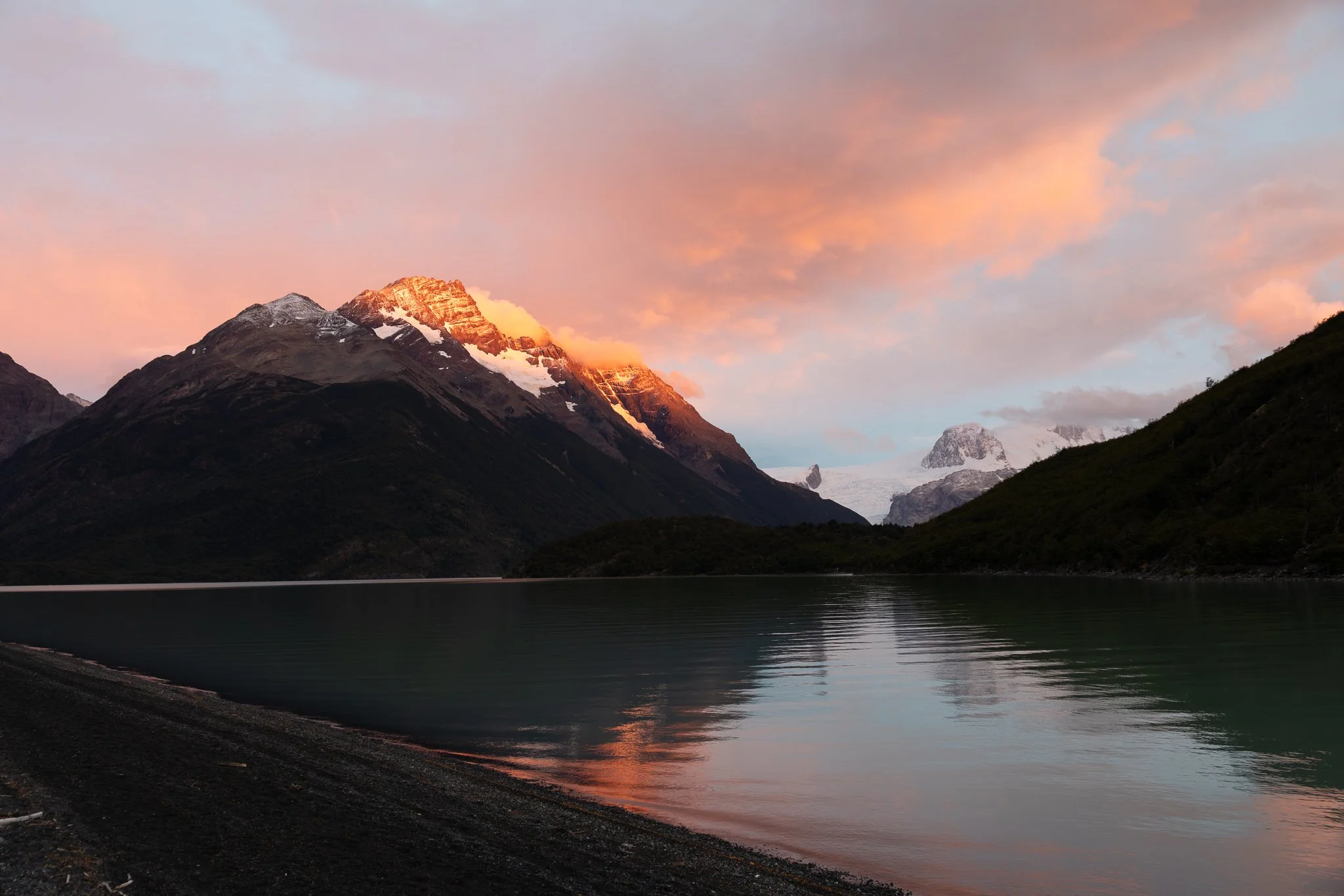
Sunset from Refugio Dickson on day three. This is the view you come back for.
The North: Remote, Quieter, Extraordinary
The northern section of the O Circuit — the part most trekkers who only do the W Trek never see — is rawer and more remote than the southern side. There's no single iconic landmark driving people here. What you get instead is sustained, accumulated beauty: glacial rivers, open pampa with guanacos watching from the hillside, and long days of genuine wilderness.
On the approach toward Los Perros and beyond, the trail crosses water constantly — sometimes on proper bridges, sometimes on planks laid over stream beds, occasionally with nothing more than stepping stones. I photograph these crossings every time. There's something honest about a simple plank over moving water — you commit, or you don't.
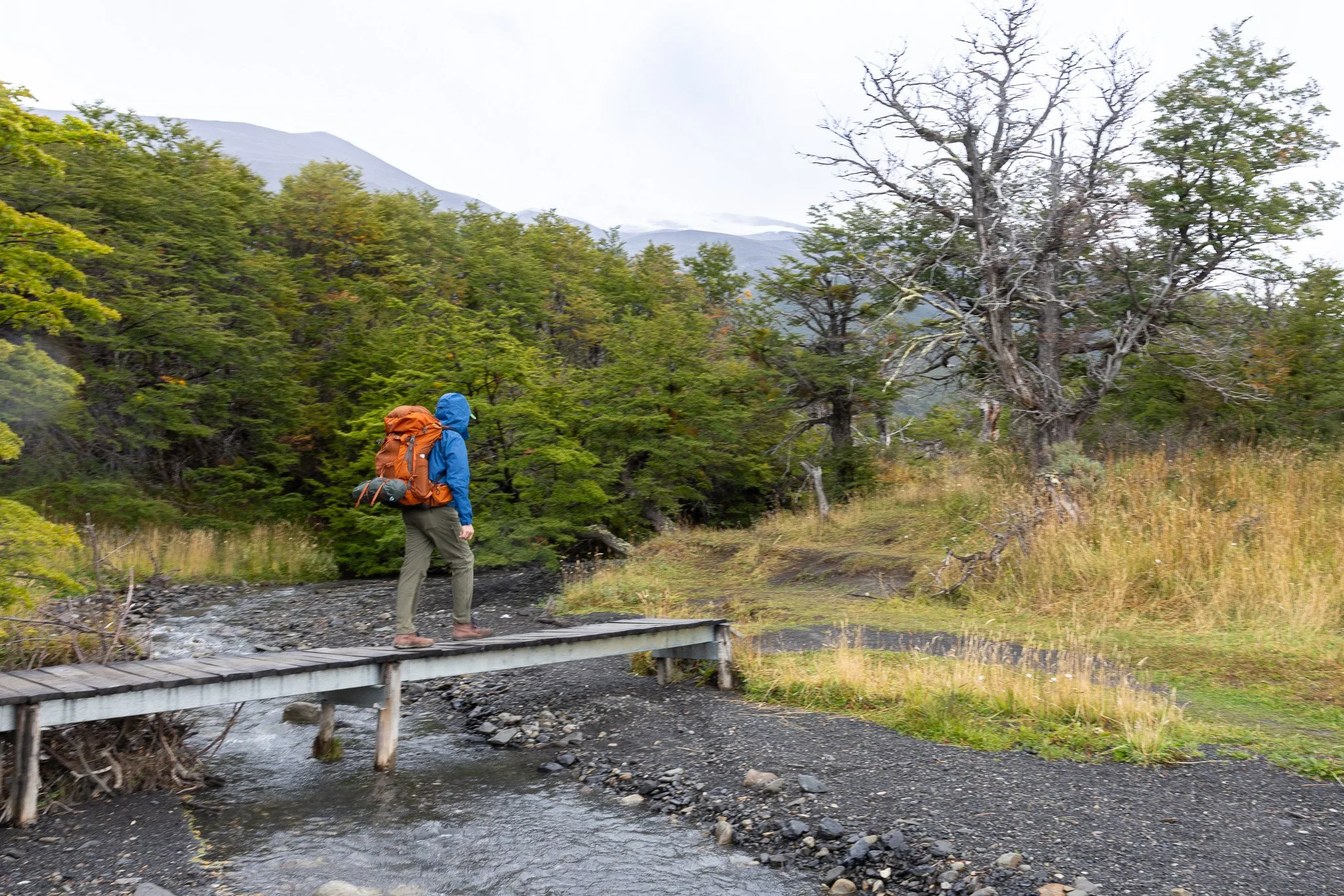
One of the many stream crossings on the northern circuit. The pace here slows you down in the best possible way.
The pace of a multi-day trek is fundamentally different from a day session. On a day session I'm always watching the clock. Here, we have eight days. That changes everything. I can walk ahead and wait. I can return to a composition I wasn't happy with. I can let the weather change and come back to the same spot in different light.
It also means I'm getting up before the group. At Dickson, I was out before dawn, watching the sky turn. The photography on a long expedition isn't just about the trail hours — it's about what happens at the margins of the day, when everyone else is asleep or eating, and the light is doing something extraordinary.
Gardner Pass: The Hardest Day, The Best Views
The climb to Gardner Pass is the most physically demanding section of the O Circuit. The trail leaves the forest behind and enters a rocky, exposed world — boulders, waterfalls, scree, and a relentless uphill grade with the pass nowhere visible until you're almost on it.
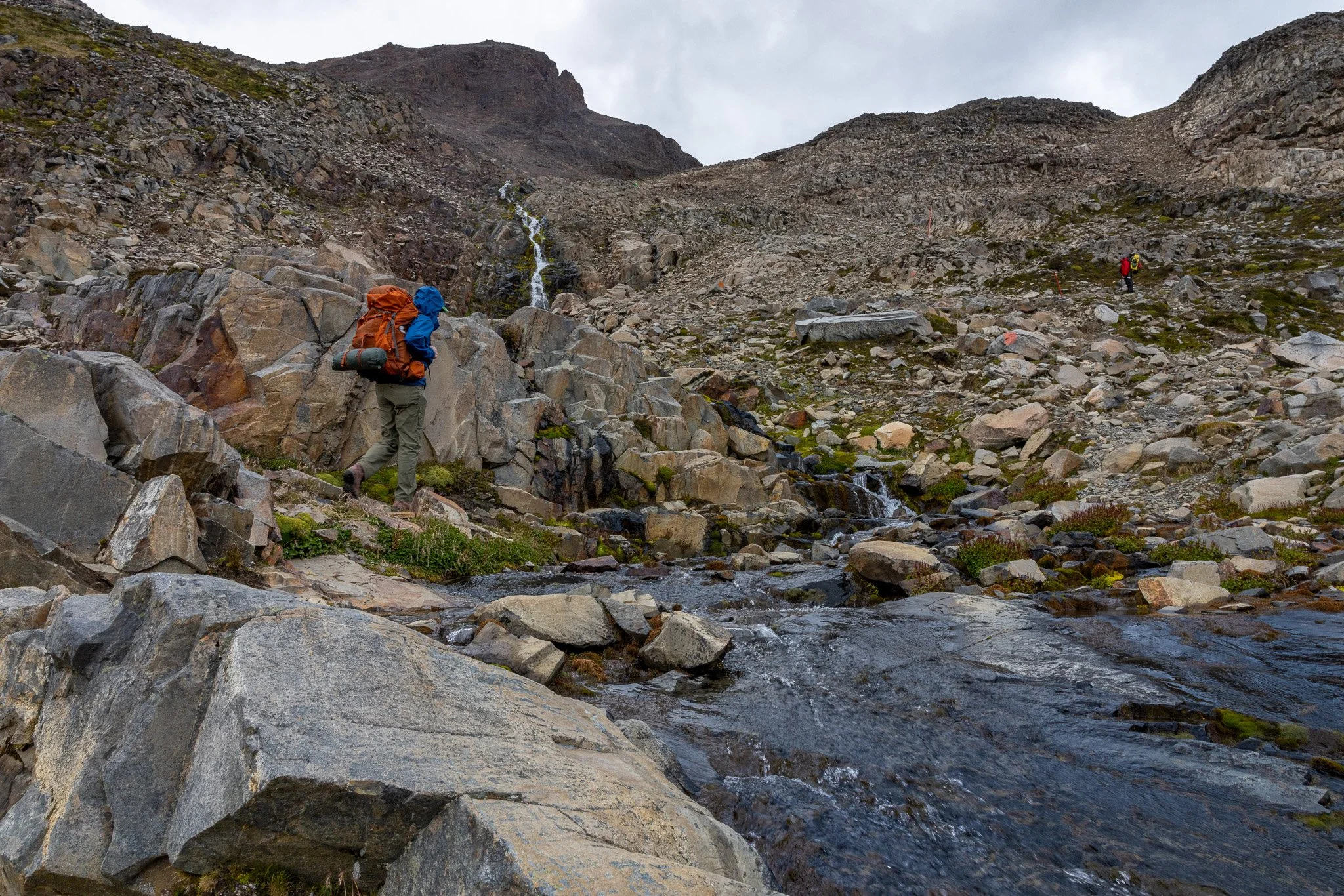
The approach to Gardner Pass — raw, exposed, and relentless. The pass is that notch in the ridgeline above.
What makes it harder is knowing that cresting the pass is only the halfway point of the day. The descent to Refugio Grey on the other side is long and demanding in its own right, with several technical sections and a trail that keeps you working for every kilometer.
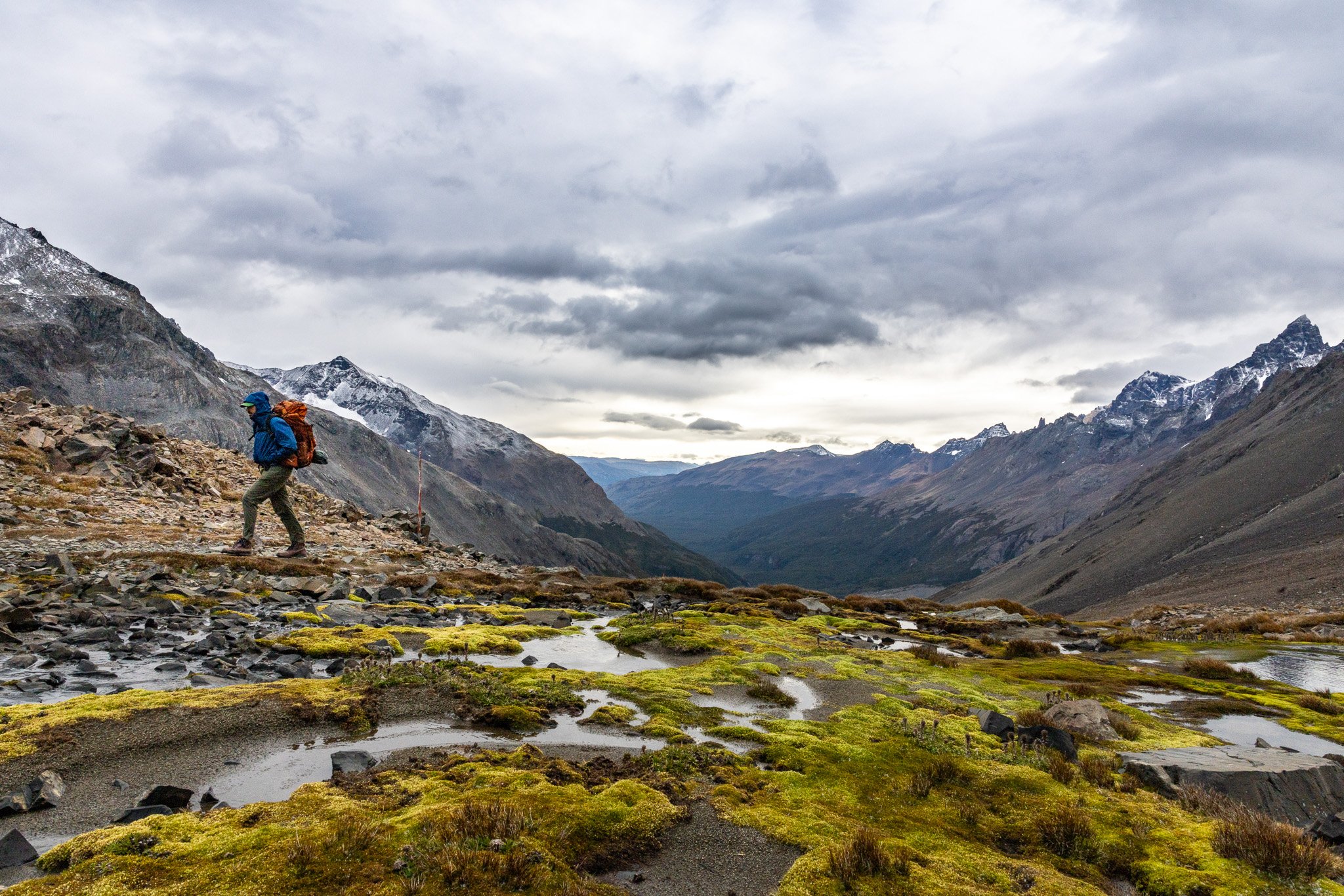
Looking back towards Refugio Dickson on the Gardner Pass.
The pass itself is a lunar landscape — flat, stony, moss-carpeted in vivid yellow-green where the ground stays wet, with small tarns sitting in the rock. The wind is usually fierce here. We were lucky with a brief calm.
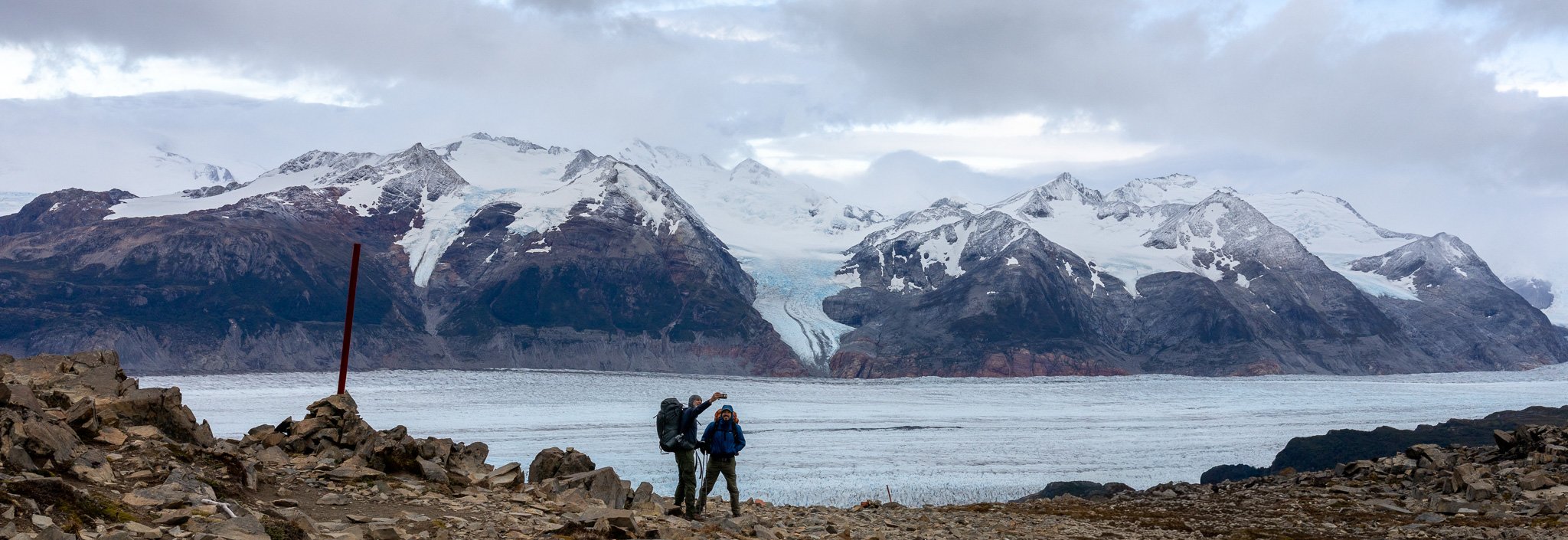
The top of Gardner Pass — a brief calm in the wind, green moss, glacial pools, and the whole of the southern circuit stretching out behind.
And then you see it. Coming over the pass and looking down toward Lago Grey, Grey Glacier appears as a wide blue river of ice filling the entire valley floor between two mountain walls. The scale is impossible to hold in a single frame. I shot a panorama and it still didn't feel adequate. Two of us stood there quietly for a few minutes before saying anything.
Glacier Grey: The Trail Along the Edge
The section from Gardner Pass down to Refugio Grey is where the photography becomes almost effortless — and almost impossible. Every angle has the glacier in it. You're walking a narrow trail cut into the hillside above the ice, occasionally scrambling hands-and-feet over exposed rock, and the whole time Glacier Grey is right there — so close you feel you could touch it, though it's still hundreds of meters below you.
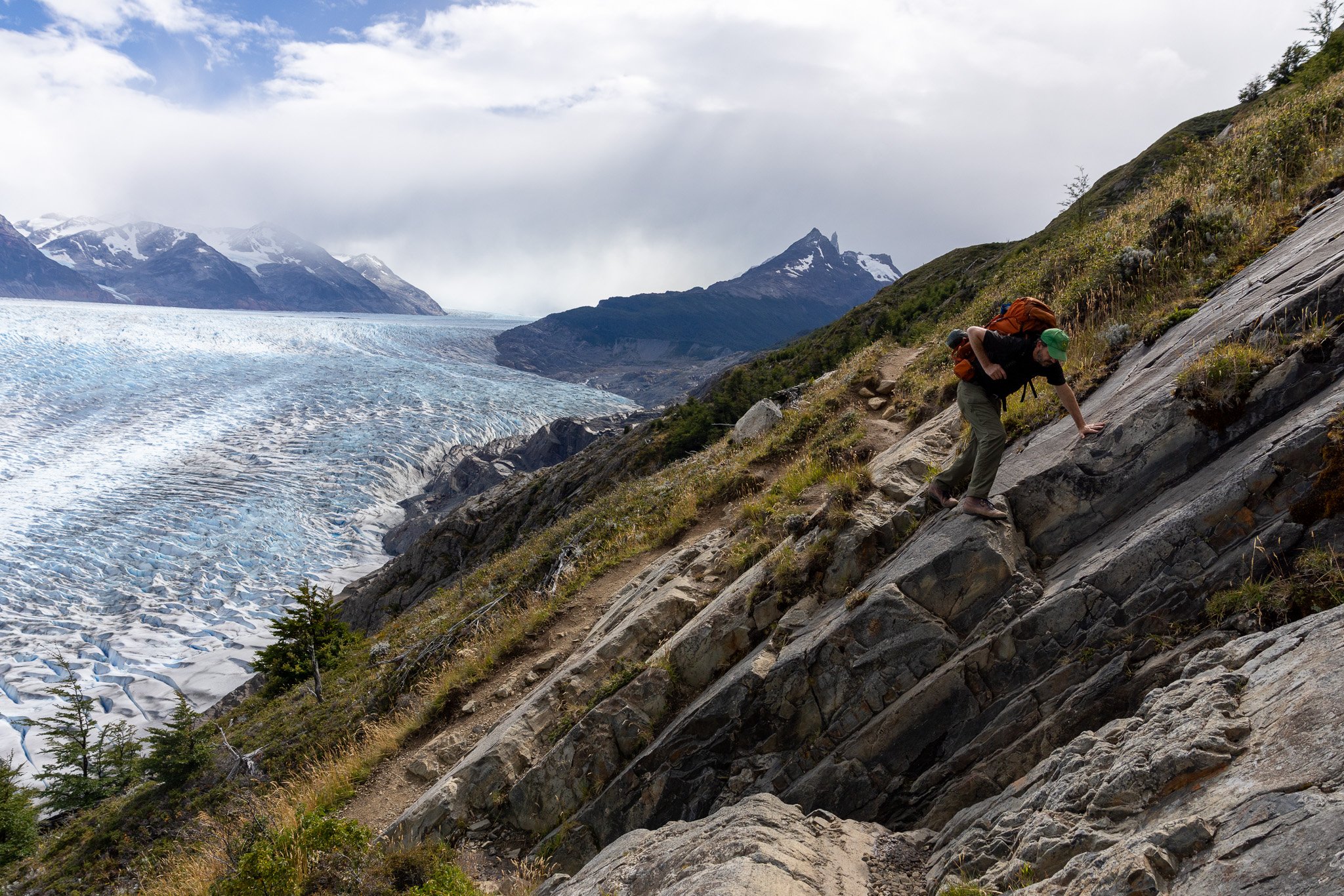
Scrambling above Glacier Grey on the descent from the pass. The trail here requires hands and feet — the kind of terrain you don't forget.
The blue of the glacier ice is a blue I've never seen anywhere else. It comes from the compression of snow over centuries, pushing out the air bubbles that make ice appear white, leaving behind a dense, deeply saturated colour. Photographs approximate it. They don't quite capture it.
At Refugio Grey, the trail drops to lake level and you walk through forest right at the water's edge. Icebergs — calved from the glacier's face — drift past at eye level. Some are the size of cars. Some are the size of houses. Photographing them at dusk, in flat grey light with the glacier face visible beyond, is one of the strangest and most beautiful things I've done with a camera.
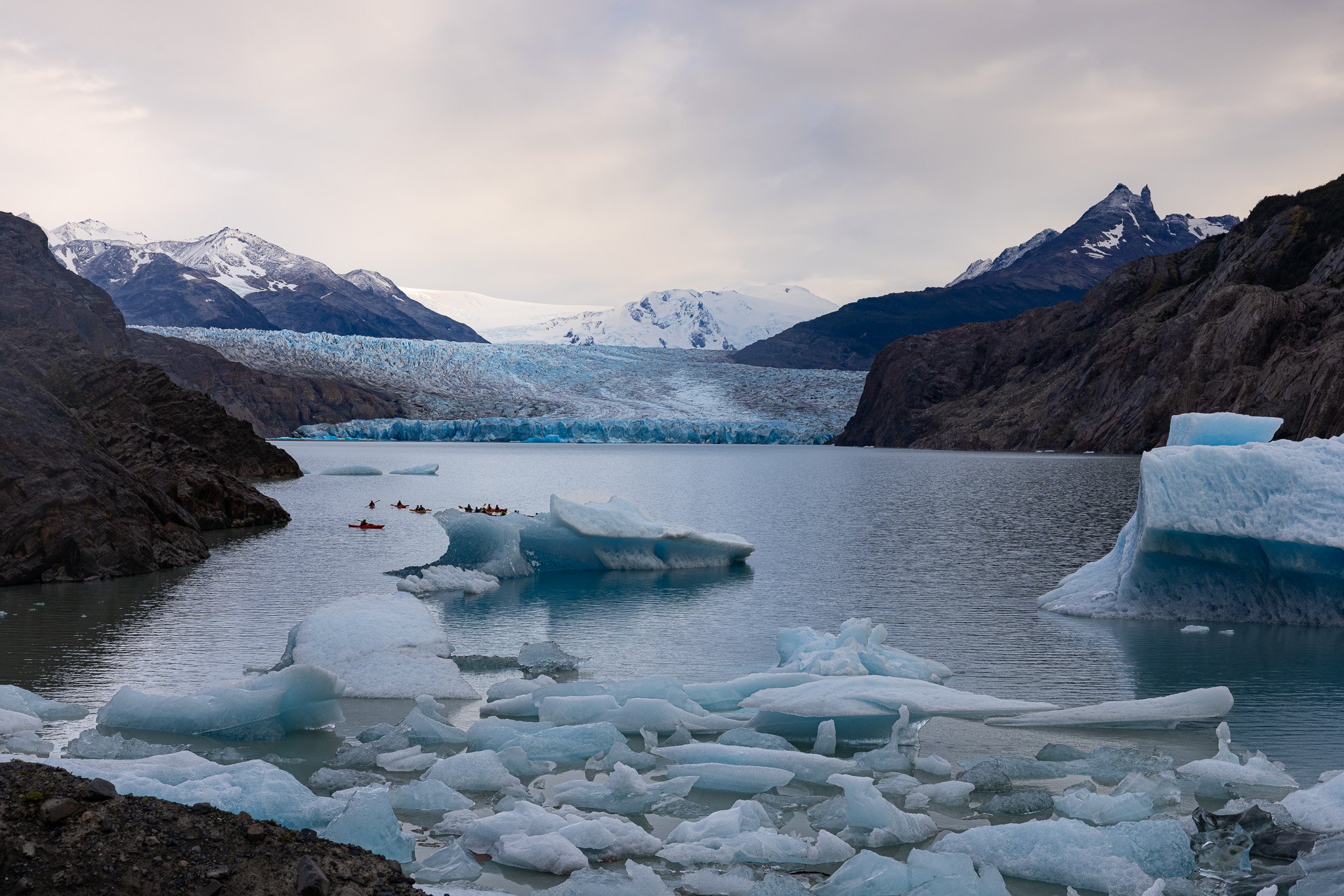
Icebergs at dusk on Lago Grey. Kayakers are visible in the distance, which gives a sense of scale.
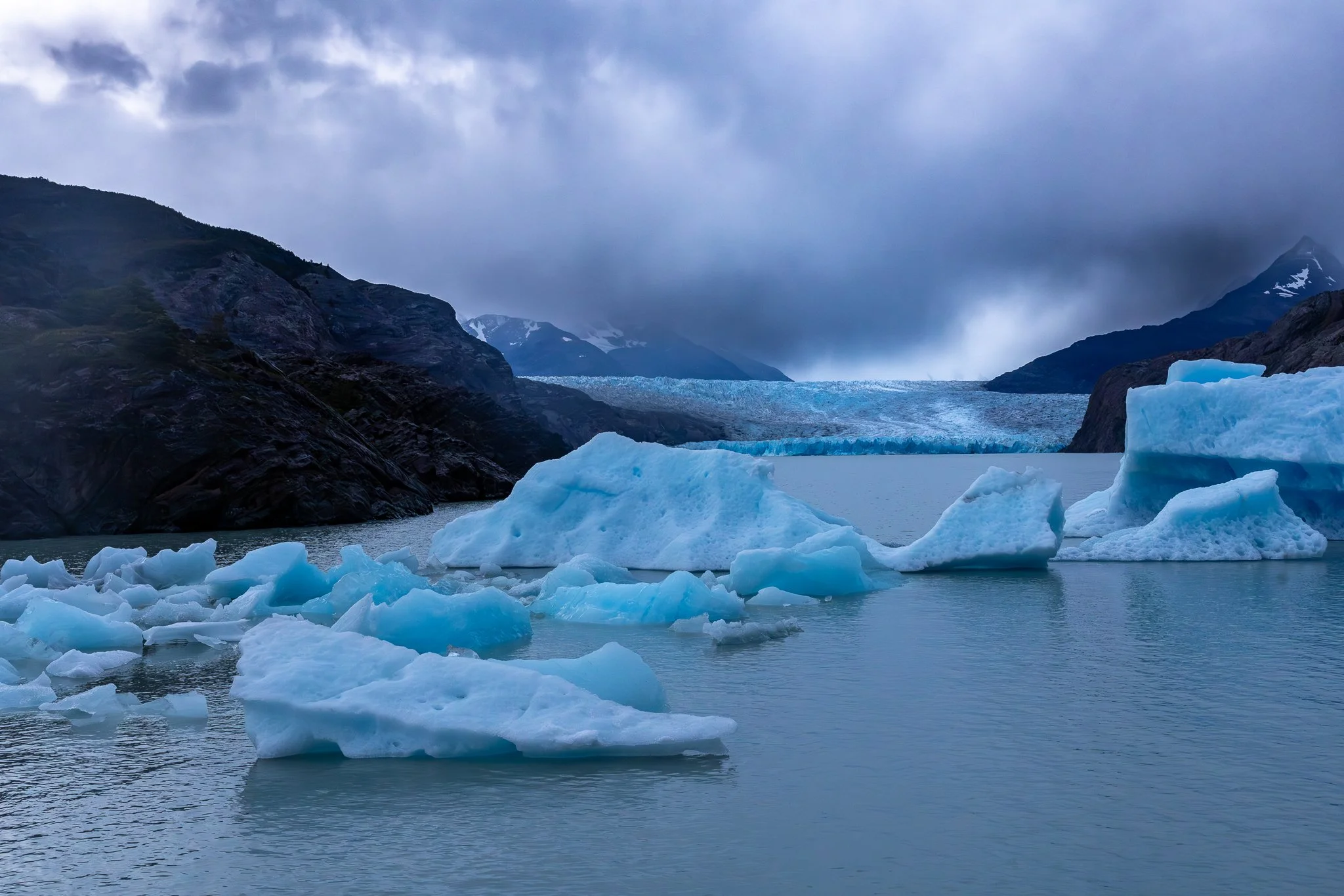
Lago Grey before sunrise — the icebergs change character entirely in low light.
The suspension bridge crossing above Lago Grey is one of the great photographs of the southern W Trek section. It's long, high, and swings as you cross it, with the glacier visible beyond the tree canopy. I positioned myself at the far end and shot as trekkers came across one by one.
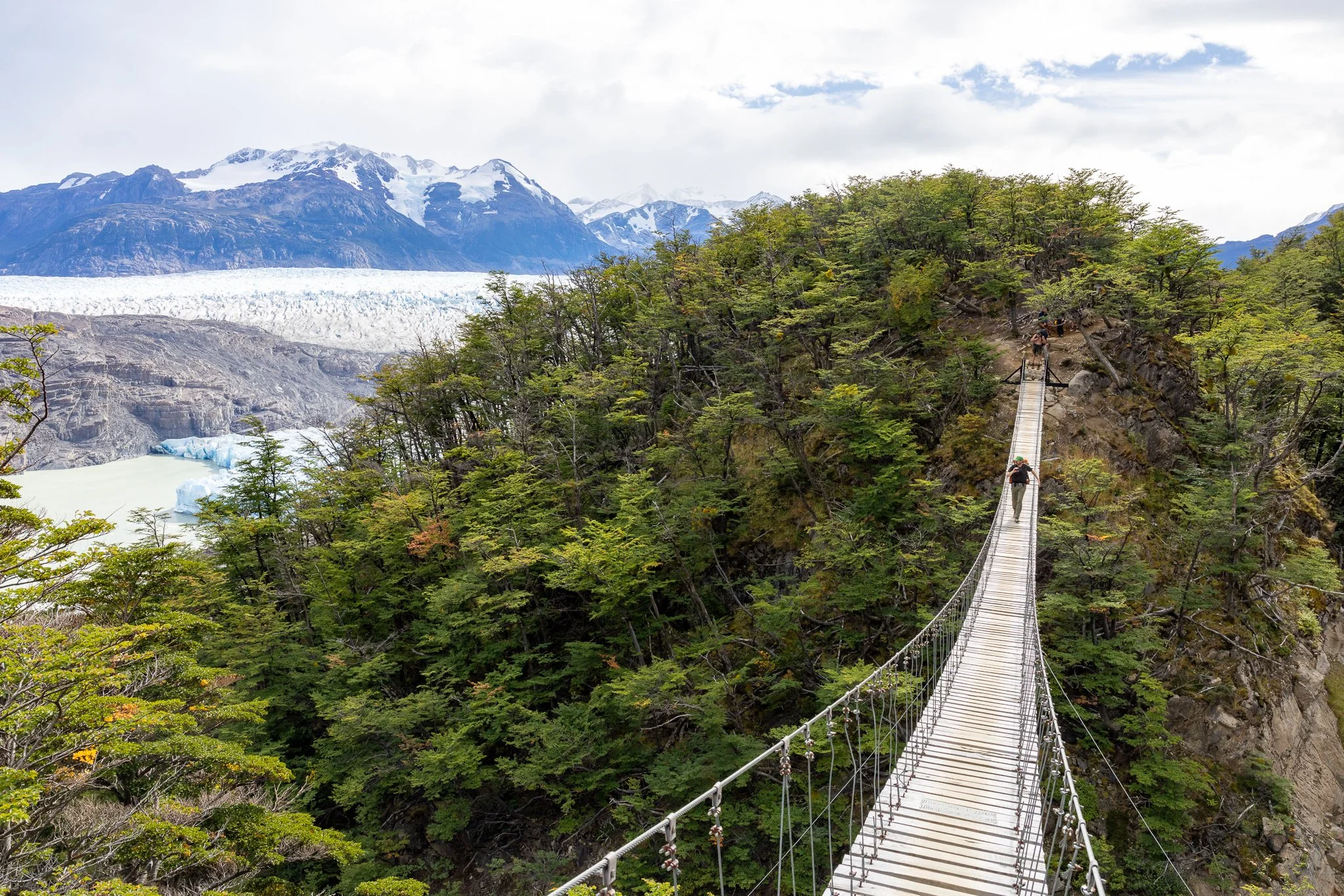
The suspension bridge near Refugio Grey — one of the best single frames from the trip.
The W Trek Section: Snow on the Cuernos
The final days of the circuit transition into the W Trek section, which means more trekkers, better-maintained trails, and the iconic landscape around Los Cuernos. We arrived after a fresh snowfall that dusted the Cuernos massif in white. The twisted, fire-scarred lenga trees along this stretch — silver-grey against the snow-covered peaks — created a kind of eerie beauty that I wasn't expecting.
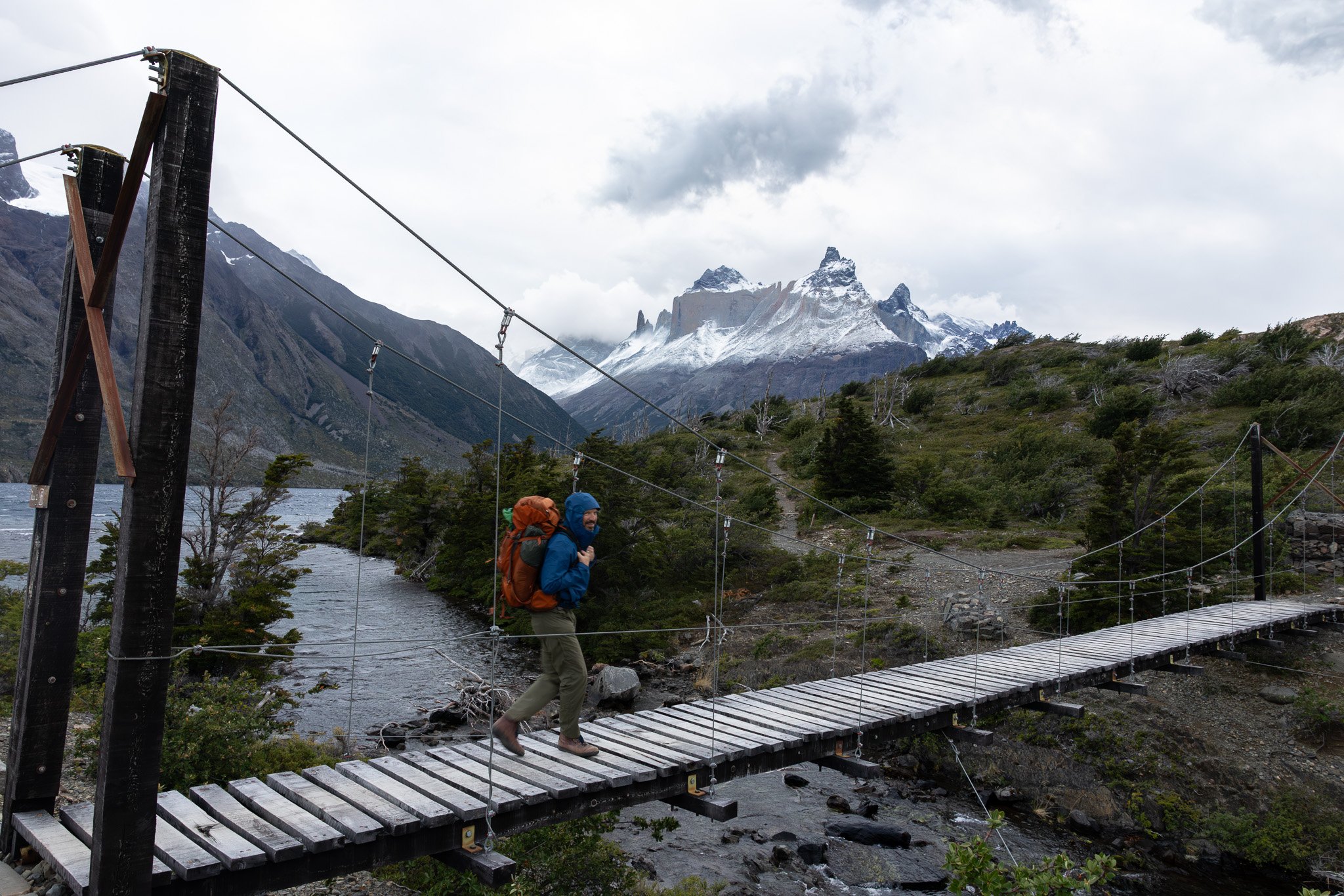
Crossing one of many suspension bridges - this was a high wind day!
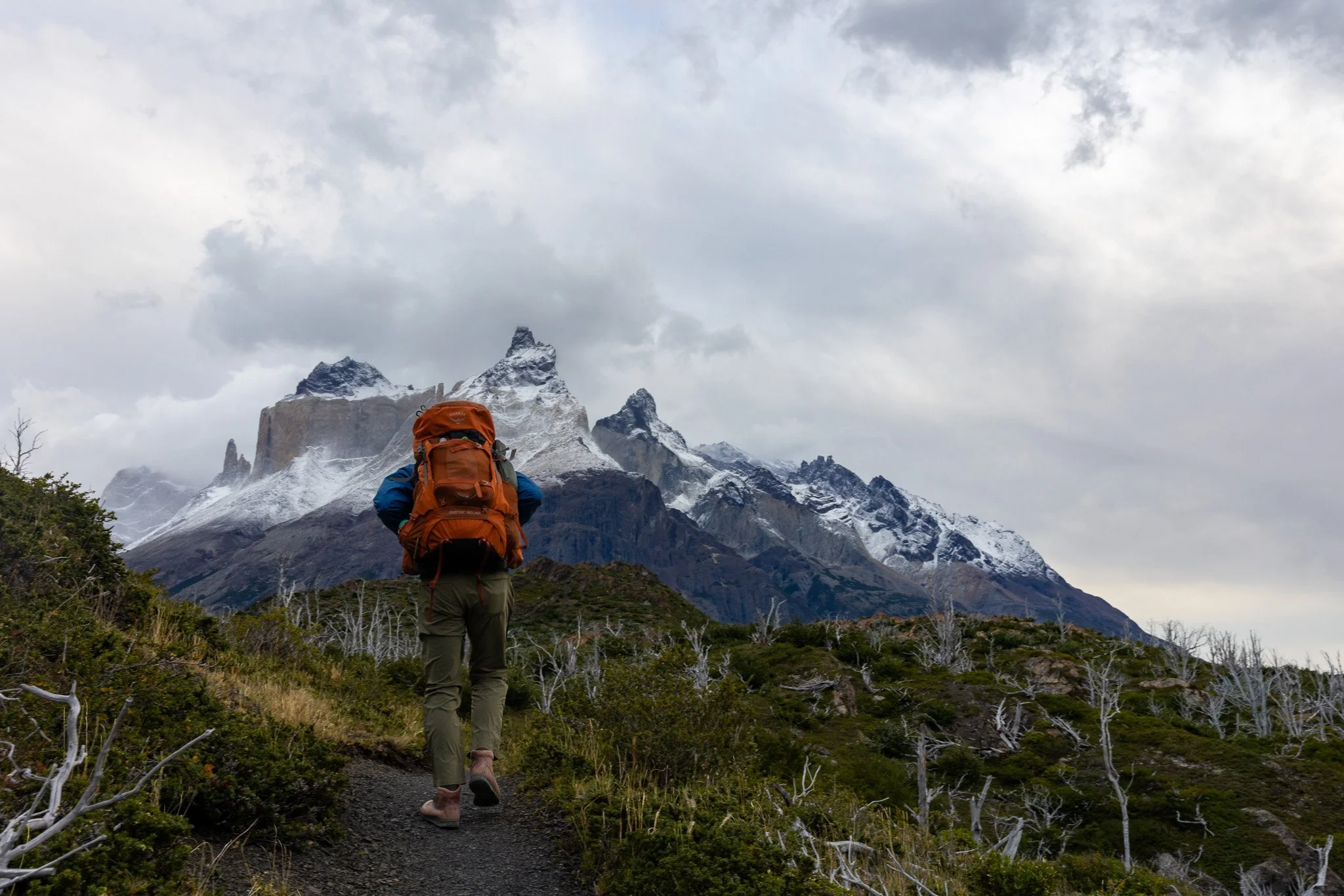
It is hard to describe the beauty - Los Cuernos Massif in the background - and our destination.
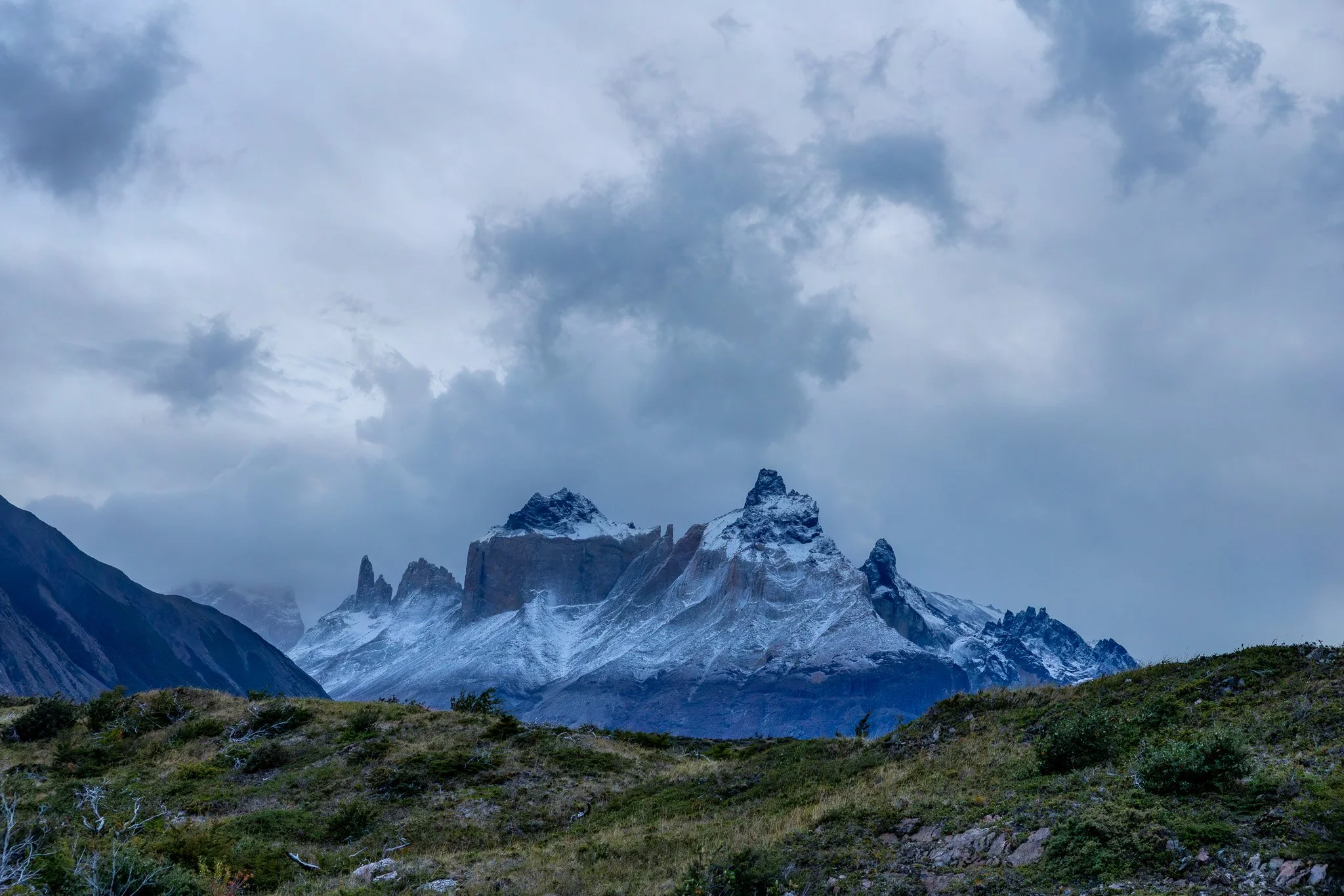
Los Cuernos - Behind this is the Francis Valley leading to Mirador Brittanica.
The Cuernos — the horns — are a different kind of dramatic to the Torres. Where the Torres are vertical and austere, the Cuernos are wide, layered, and almost theatrical. Fresh snow on those angled golden-orange rock faces, with storm clouds building behind, made every few minutes feel like a different photograph.
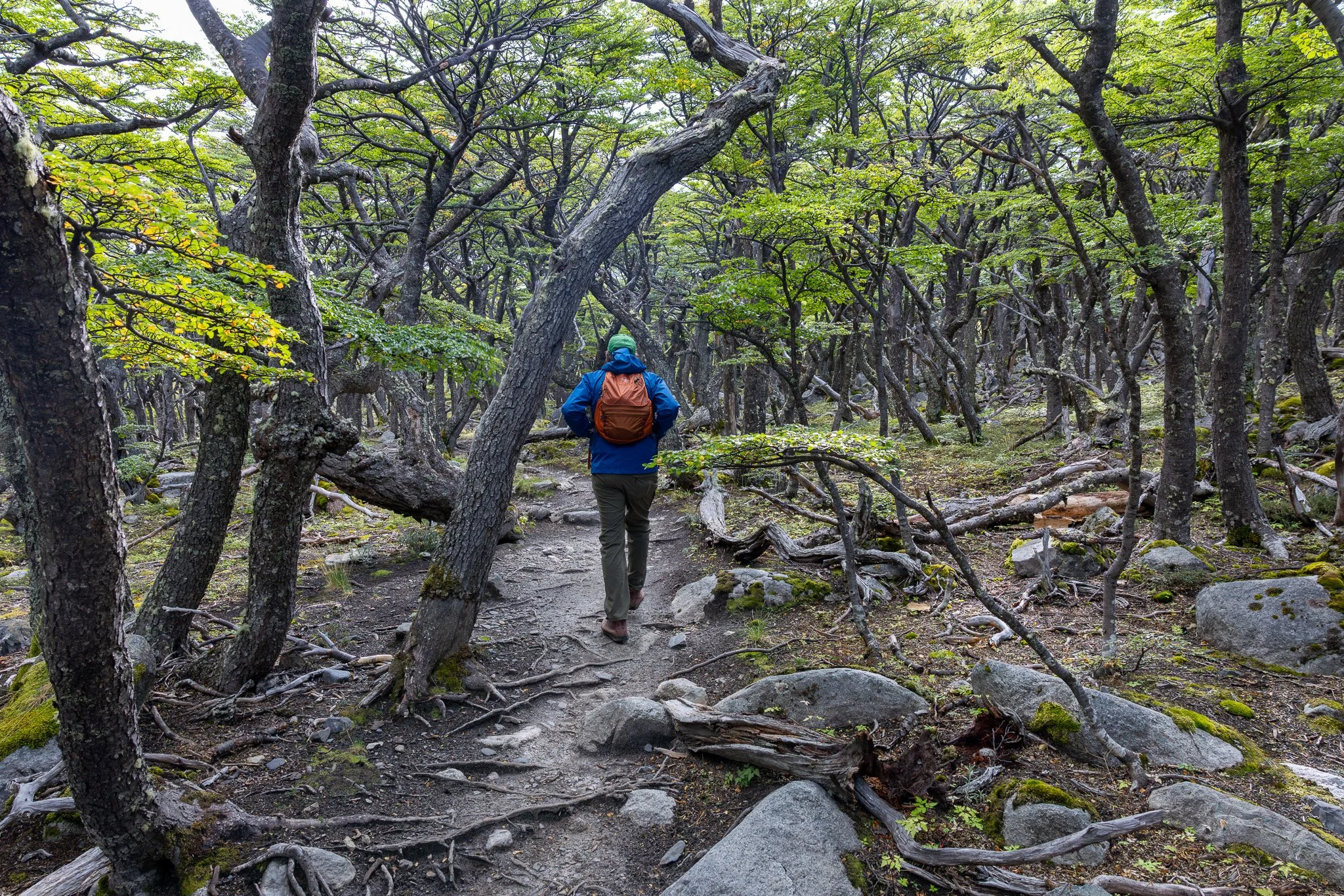
The hiking trail varied from forests to wide open spaces. But it was always spectacular!
Torres Base: The Reason You Set the Alarm
The Torres del Paine — the three granite towers the park is named for — are best seen at sunrise. Conditions deteriorate as the day progresses and fog can obscure them entirely by mid-morning. We hiked up in darkness, headlamps bobbing through the beech forest.
When the towers appeared, the first light was just catching the granite — warm amber hitting the vertical faces while the lagoon below was still in shadow. Within a few minutes the reflection formed and stilled. I was shooting with both hands and forgetting to breathe.
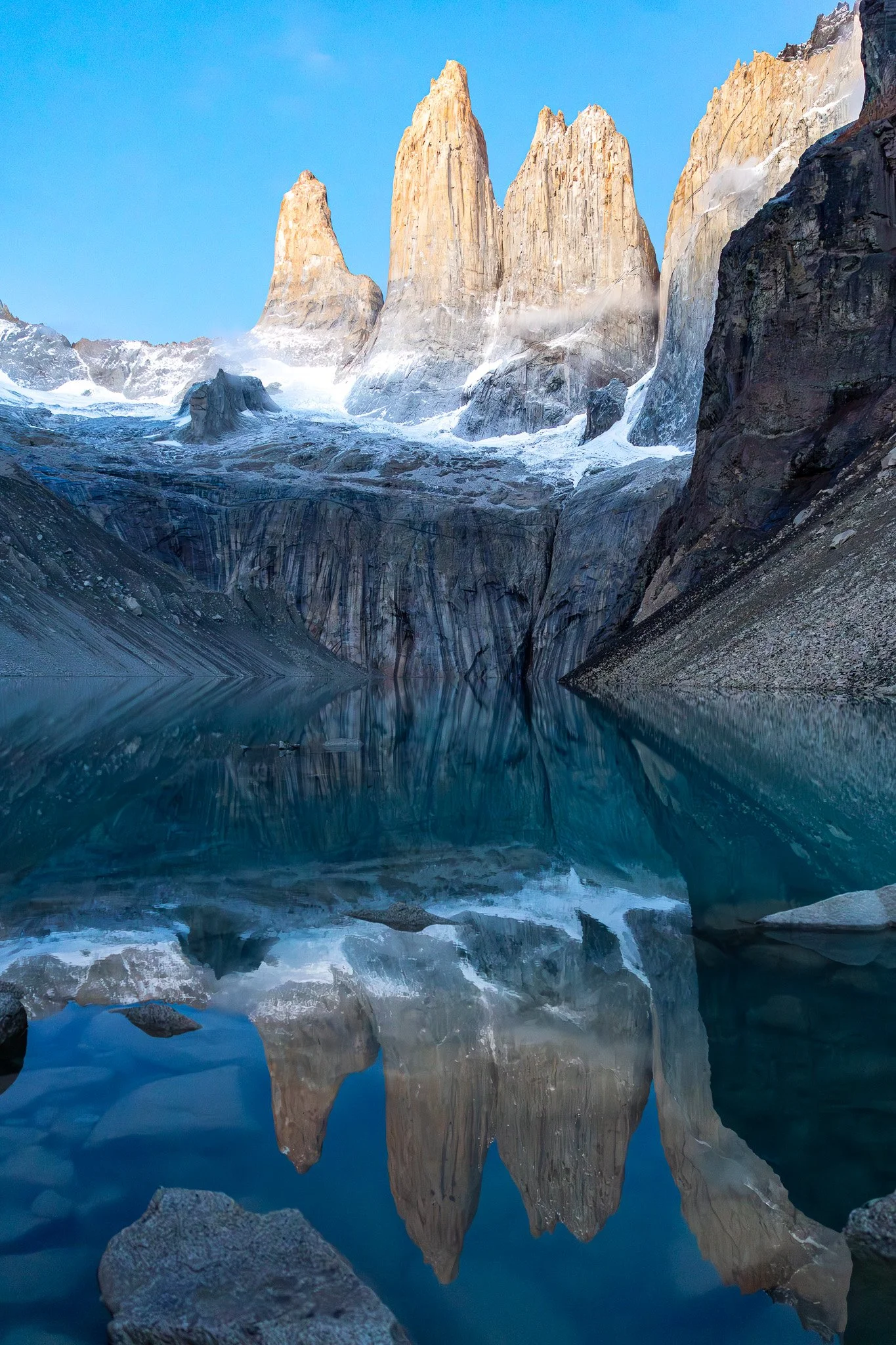
The Torres del Paine at first light, reflected in the lagoon at Torres Base. This is why you set the 2am alarm.
This is the shot that exists in the photography of every person who has walked the O Circuit. I've seen hundreds of versions of it. And yet standing there, watching the granite turn gold in real time, I understood why people keep coming back to make their own version. The photograph doesn't fully explain the feeling. Nothing does.
What This Kind of Photography Actually Is
People sometimes ask me what the point is of hiring an adventure photographer for a trek like this. They have phones. They have their own cameras. They'll take plenty of photos themselves.
Here's what I'd say: the photos you take yourself are about what you saw. The photos I take are about what you looked like living it — the real shape of effort, the authentic expression of wonder or exhaustion, the moments that are impossible to self-document because you were too busy actually having them.
On a trip of this scale, those moments accumulate into something. Eight days of real effort, in one of the most dramatic places on Earth, documented by someone who was there for all of it — not just the iconic views, but the plank bridges and the moss and the dawn light at Seron and the rain gear that spent two days doing its job.
These photographs are what that looked like.
About This Session
This was an eight-day full O Circuit photography session in Torres del Paine, Chile. My action sports and adventure photography sessions are designed for people who'd rather be moving than posing — I come to you, in your element, carrying my own gear, and I photograph the real thing.
If you have a big adventure planned — a trek, an expedition, a bucket-list trip — and you want photographs that actually show what it was like to be there, let's talk.
And if you're planning the O Circuit yourself, start with the tips and logistics guide — everything I learned about gas canisters, refugio food, puma sightings, and what the internet gets wrong about cash.