
In early November I photographed a wingfoil session at Shoreline Lake in Mountain View. The rider works at the Shoreline Lake Boathouse and wanted action shots of his riding, plus a few portraits with his gear once the sun went down. We shot across the lake on a Wednesday afternoon with a northwest wind, then finished with golden hour portraits on the lawn.
This one was personal for me. When I was a kid, every weekend, my parents drove me down to Narrabeen Lakes in Sydney to windsurf. I learned on a HiFly 555 and graduated to a Bombora tri-fin, a little wave jumper that I was probably too small for. So when I drive to Shoreline and see the foilers out on the lake, I always stop to watch. When this inquiry came through, I said yes before I finished reading it.
Wingfoiling looks simple from the shore. Photographing it well is mostly about understanding the wind, the sun and how the rider moves, and then putting yourself in the right spot. Here's how I approached it.
Planning around the wind and the sun
The hardest part of this session was picking the day. It was the end of the season, and a wingfoiler needs real wind to get up on the foil. The rider watched the forecast and told me only one afternoon that week looked good: Wednesday, with the wind coming from the northwest. At Shoreline, that's the direction that blows in off the Bay and fills in reliably in the afternoon. Every other day had light, shifting wind from random directions.
We agreed on a simple rule. If the forecast that morning showed less than 9 to 10 knots, he'd call it off and we'd move to the following week. Below that, he can't get the board up on the foil, and there's nothing to photograph except a man standing on a paddleboard holding a wing. The wind came through, somewhere between 12 and 30 knots.
The sun was the other half of the plan. In November it sets around 5pm, so a 3:30 start gave us the afternoon wind on the water and the last of the warm light for portraits. When I arrived and looked out from the jetty, the sun was still high over the lake and the water was a sheet of silver glare. Shooting into that would have put his face in shadow and flooded the frame with flare. So I walked around until the sun was behind my shoulder. That lit his face, turned the water deep blue and kept the colors clean. I saved shooting into the sun for the end, when it dropped toward the hills and the sparkle on the water became a backdrop for silhouettes instead of a problem.
A little wingfoil physics, and why it decides where you stand
If you want action photos of a wingfoiler, it helps to understand how they move. Three things shaped every decision I made on the jetty.
The reach is the fast leg. A wingfoiler goes fastest on a reach, with the wind coming across them or slightly from behind (a beam reach or a broad reach). That's when the wing is fully powered, the board rides highest on the foil and the rider looks most dynamic. Heading upwind they're slower and more hunched over. Dead downwind the wing loses power. So the photos you want are on the reaching legs.
Jibes are better than tacks. To change direction, a rider either tacks (turns through the wind) or jibes (turns away from it). On a wingfoil, a tack is hard. The wing loses power as the nose passes through the wind, the rider has to switch their feet, and most riders lose their speed and drop off the foil. A jibe carries the speed through the turn. The board banks, the rider leans into the carve, and the wing flips overhead to the new side. That's the most dramatic moment in the sport, and it's the one I wanted.
Position yourself so the reach comes toward you. The ideal setup is a rider reaching toward you at an angle, not straight across in front of you, so you see his face and not just the side of the wing. Then he jibes roughly 100 meters out and heads back. On Wednesday the northwest wind brought him in toward the jetty, so the jetty was the right place to stand. Before he launched, we agreed on where I'd be and roughly where he'd turn, so his jibes happened in my sweet spot.
The distance matters for lens choice. At 400mm, a rider 100 meters away fills about a third of the frame height in a horizontal shot. At 200mm he's about half that size. That's the main reason I switched lenses partway through, which I'll get to next.
Gear and camera settings
I shot on a Canon R5 Mark II and started with the EF 70-200mm f/2.8L. It's fast and sharp, and with 45 megapixels I knew I could crop a long way into the frame. Once the rider was working the far side of his reach, I switched to the EF 100-400mm f/4.5-5.6L to get closer without cropping as hard. Both are EF lenses running through the RF adapter, and autofocus kept up fine.
I also own a 1.4x extender, but I left it in the bag. It costs a stop of light and slows the autofocus a little, and on a moving subject I'd rather crop a sharp frame than chase a softer one.
The settings were simple:
Shutter speed: I used auto ISO with a minimum shutter speed, so on the 100-400 the camera held 1/800 and adjusted the ISO. On the 70-200 wide open, it had light to spare and went up to 1/2500.
Aperture: f/2.8 on the 70-200, and f/5 to f/5.6 on the 100-400 depending on how far I was zoomed in.
ISO: auto, and it stayed between 100 and 200 the whole time because it was so sunny.
Autofocus: servo with subject tracking, burst mode.
The last point matters more than the numbers. With a fast sport, you can't predict the exact split second where the spray, the wing and his expression all line up. So I shot in bursts through every jibe and every trick and found the peak frames afterward. I came home with about 3,000 frames from the session.
The action shots
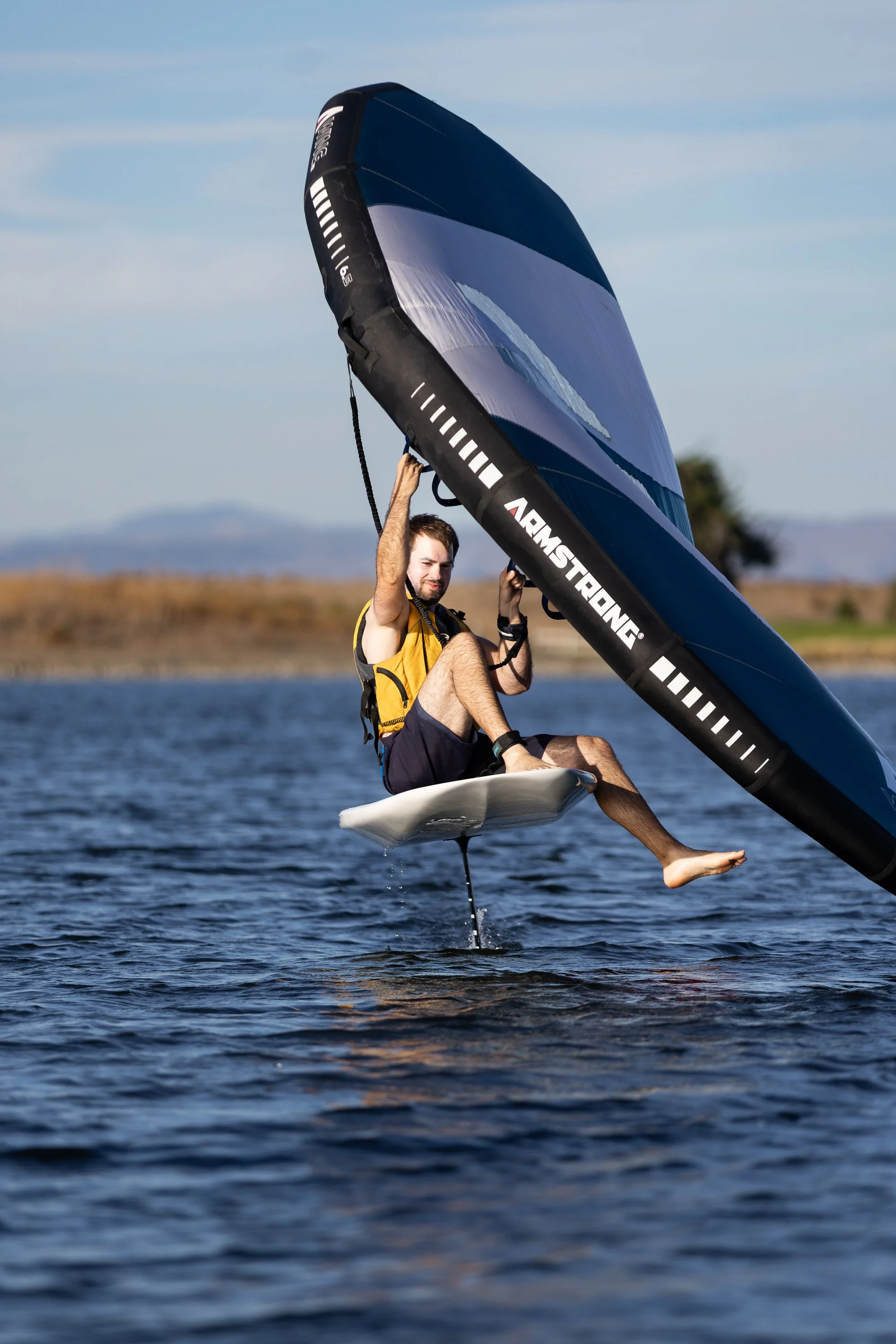
The trick he'd been waiting to show me.
This is the trick he'd told me about before the session: sitting down on the board while it's still flying on the foil, one foot out, looking straight at the lens. The mast is clearly visible in the water, which is what tells you he's flying and not just floating. It's his favorite frame from the day, and mine. (70-200mm at 200mm, f/2.8, 1/2500, ISO 100.)
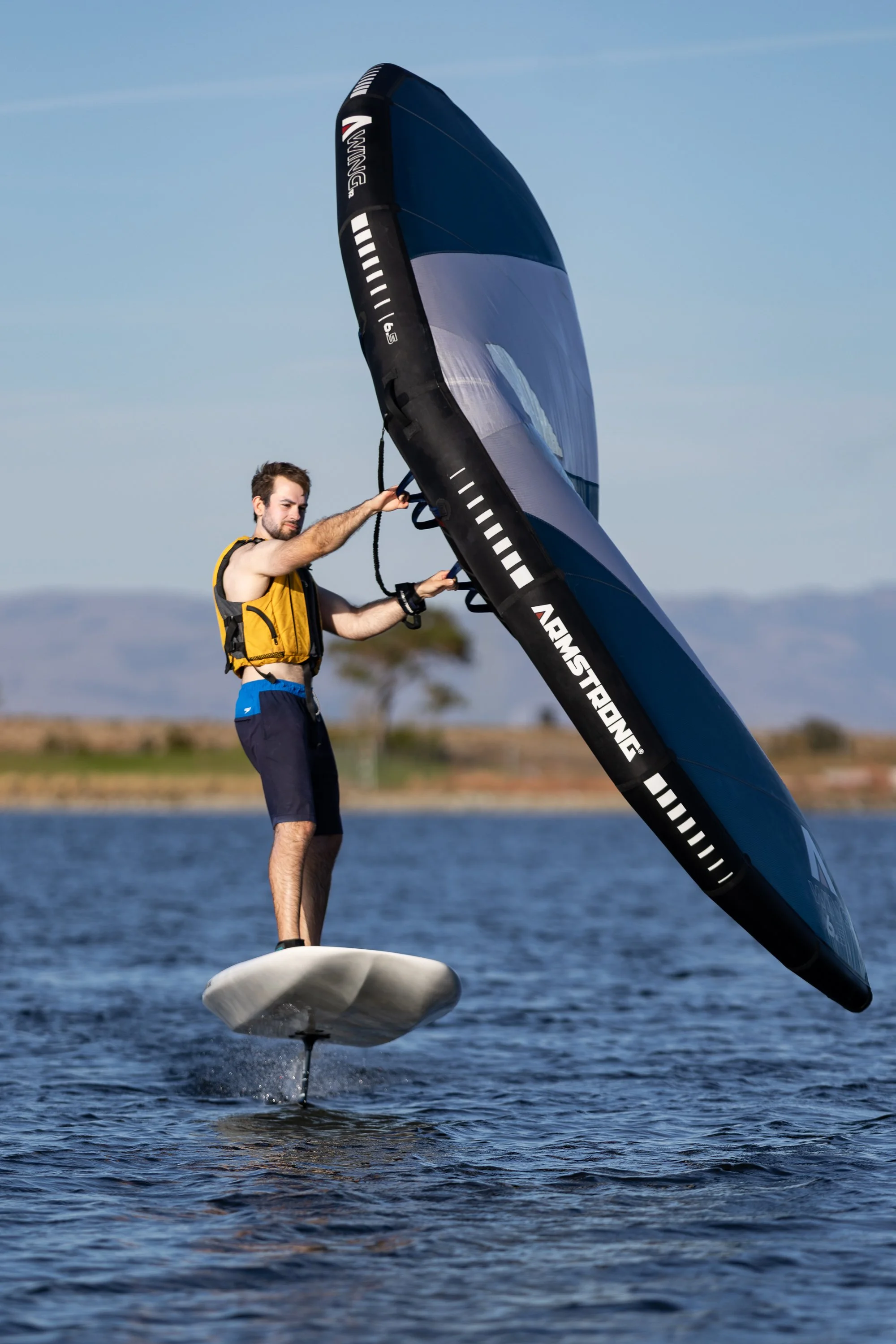
Up and flying.
Up on the foil with a grin. This is the one that shows what the sport feels like from the inside.
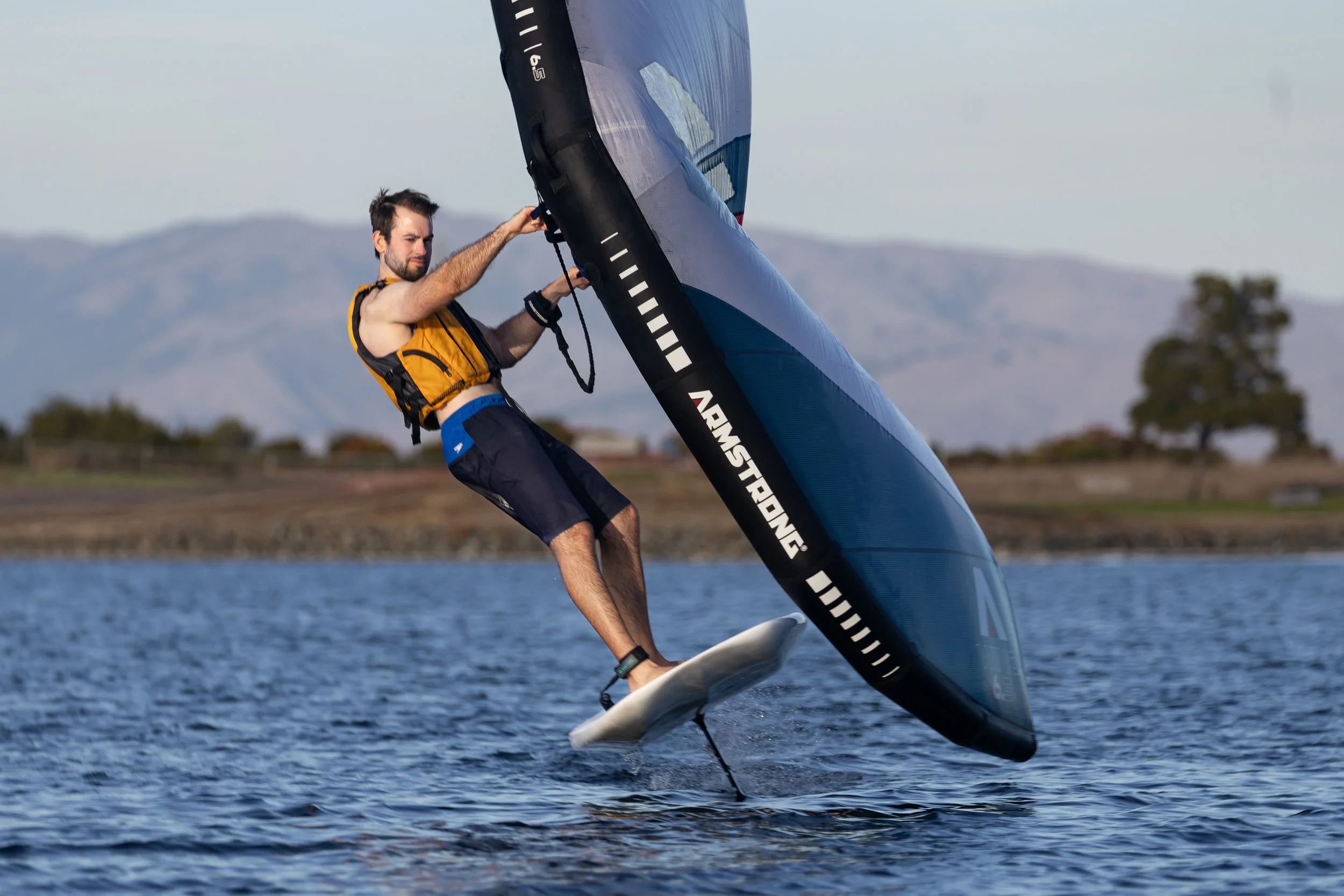
Full power on a reach.
Leaning back hard with the board canted and the mast slicing through the water. Of all the horizontal frames, this one gives the strongest sense of speed.
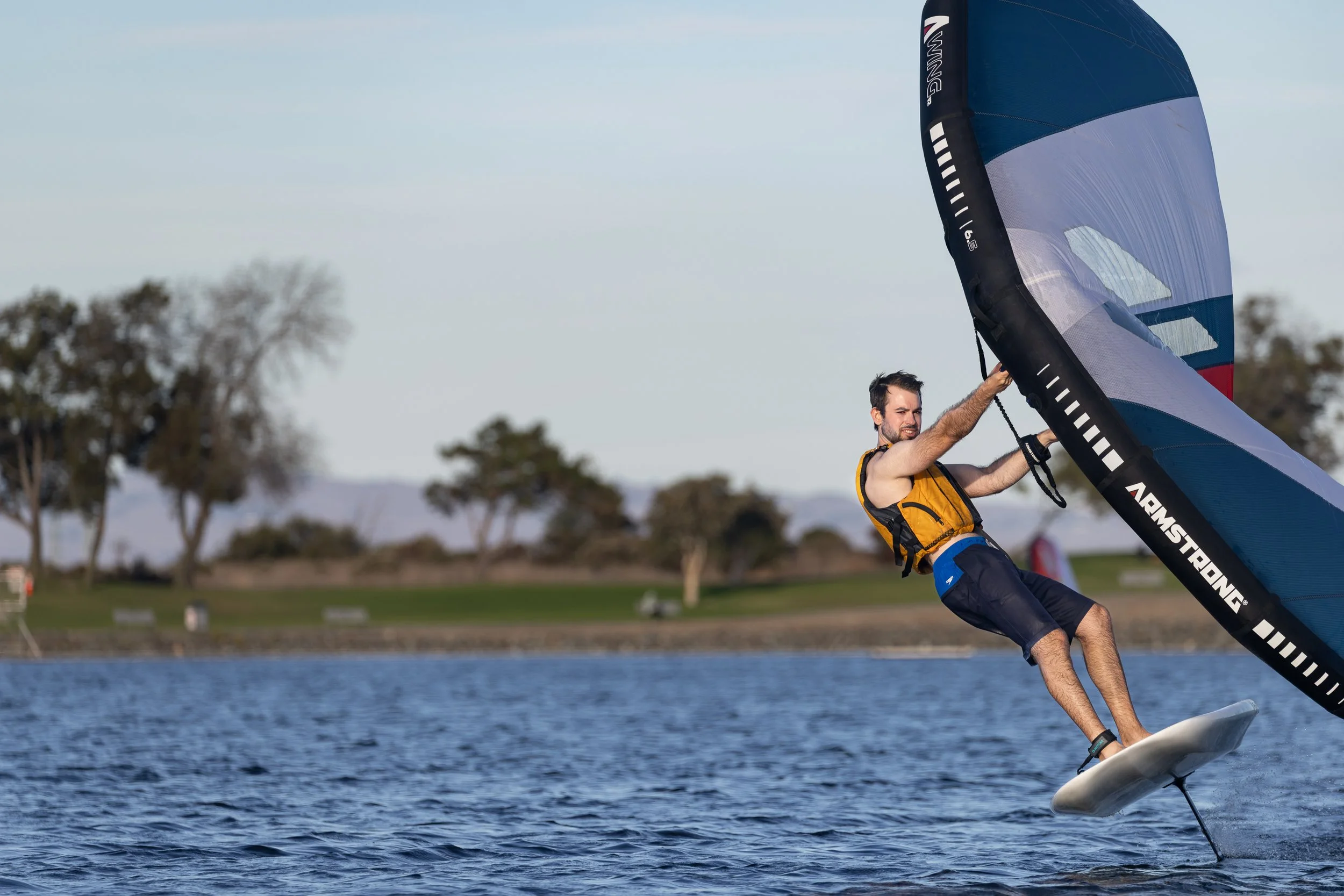
Heading for open water.
He's at the far edge of the frame, facing into open space, with the wing bleeding off the side. I like the energy of leaving the wing partly out of the picture.
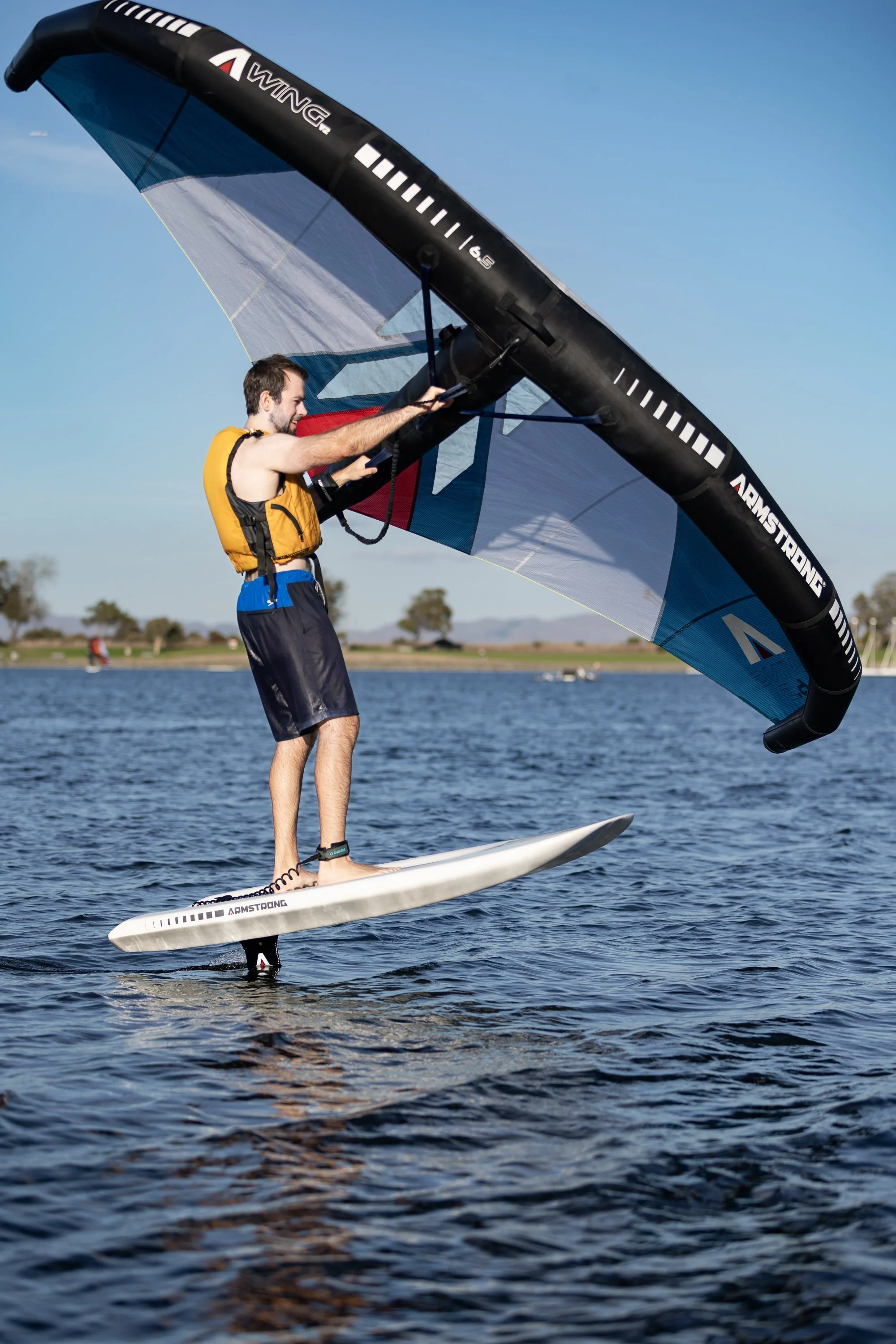
Wing, board and foil all working.
The gear in full view: wing, board and foil all working together.
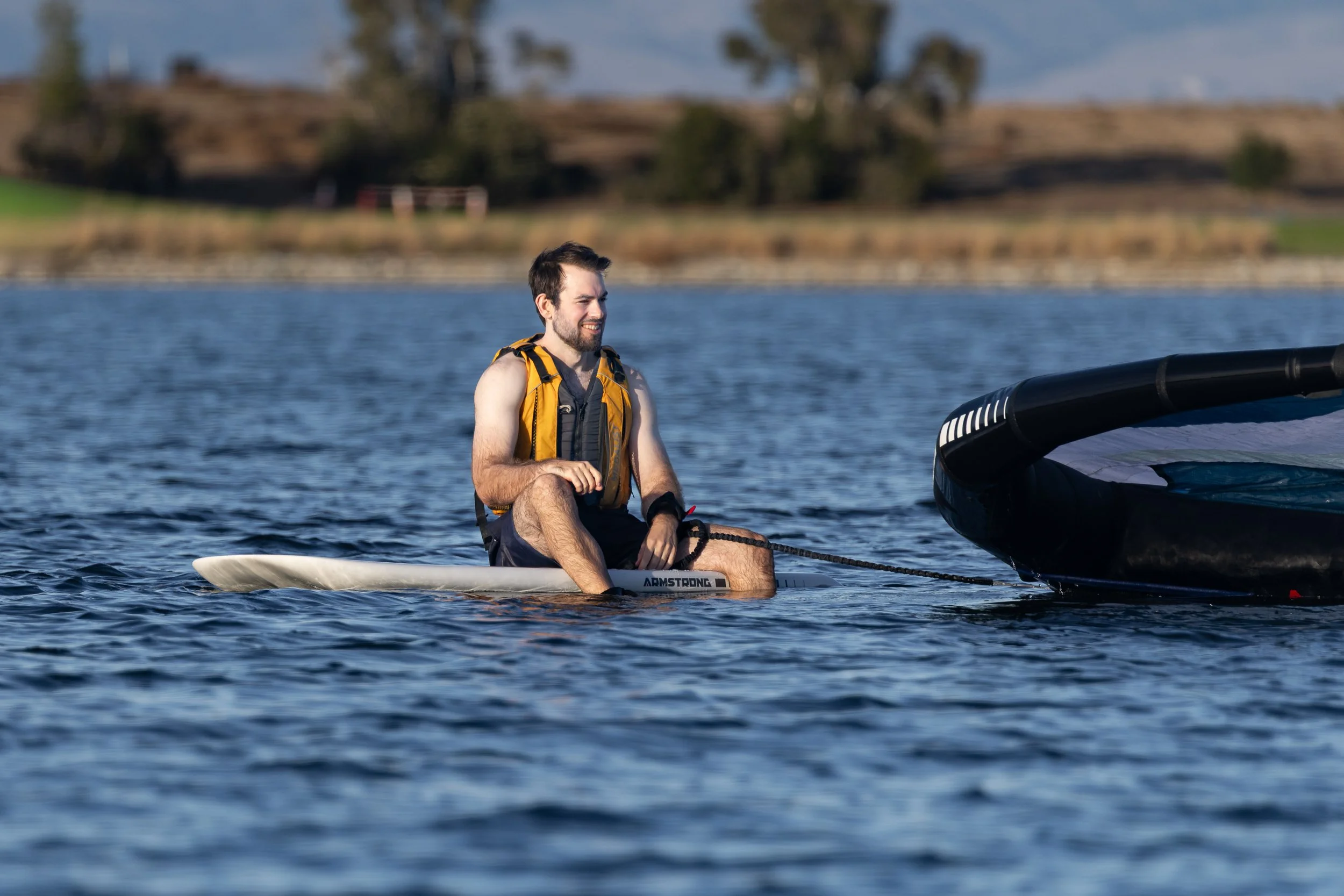
Between runs.
Between runs, sitting on the board in the water with the wing down, laughing. Not every good action frame has action in it. This is the most human moment from the water.
Wingfoiling also involves falling off, often. I have a lovely sequence of a wipeout, but since it's shot from behind, it stays in his gallery and out of this post.
Why Shoreline Lake is a great place to learn to wingfoil
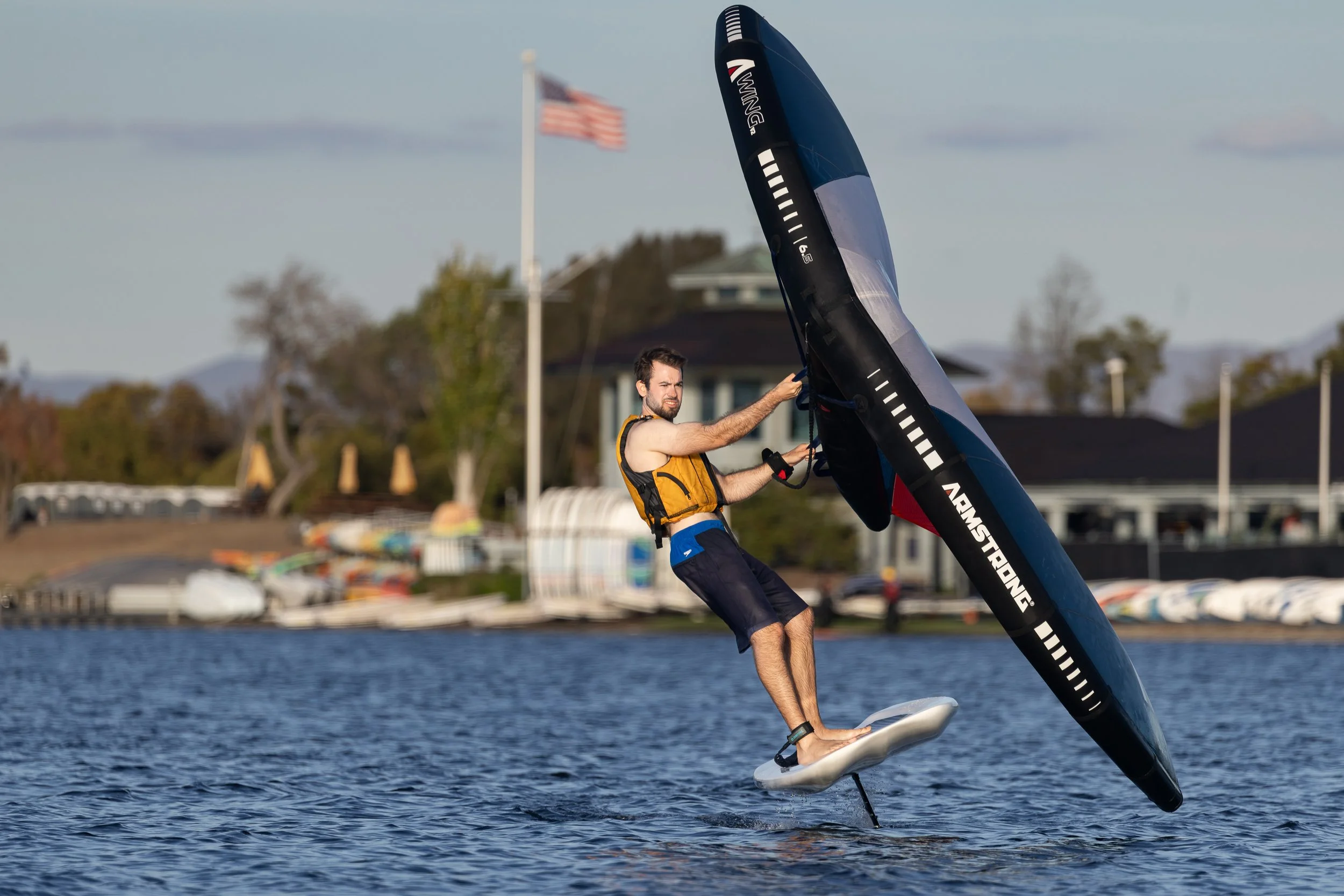
Home base.
The Shoreline Lake Boathouse, with the flag and the kayak racks behind him. This is where he works, and it's where most people start.
Shoreline Lake is a 50-acre saltwater lake inside Shoreline at Mountain View, the city's big regional park on the edge of the Bay. A few things make it a good place to learn:
It's enclosed. If you fall off and drift, you end up on a lawn or a bank, not out in the shipping channel. Compare that with the open Bay, where riders at some spots rely on rescue boats.
The water is flat. No swell, no tidal current to fight, and the lake doesn't drain at low tide the way the Baylands does.
The wind is predictable. Mornings are often light, which suits beginners. Afternoons, especially in spring and summer, bring a steadier breeze off the Bay for more experienced riders.
Lessons and gear are right there. The boathouse runs classes and rentals for sailing, windsurfing, kayaking, stand-up paddleboarding and wingfoiling.
On our day, the rider was on a 5.5 square meter wing, with a smaller one rigged and ready on the lawn in case the wind picked up. Having two sizes ready is normal for wingfoilers: a bigger wing gives more power in light wind, and a smaller one keeps you in control when it blows harder.
Lessons and getting in touch
The Shoreline Lake Boathouse is at 3160 N. Shoreline Blvd, Mountain View, CA 94043. Classes and registration are on their website at shorelinelake.com/boathouse.html. One practical tip if you're planning a late session: the boathouse is a long way in from the park entrance, so check the park's closing time before you go.
Other places to wingfoil in the Bay Area
Shoreline is the protected place to learn. Once riders outgrow it, they head for the open Bay, where the wind is stronger and the conditions are less forgiving. These are the spots I see mentioned most, from closest to Mountain View to farthest:
Palo Alto Baylands: past Palo Alto Airport and the nature center, out to the point with the small pier. I see wingfoilers here on afternoons at medium to high tide. At low tide it's mudflats, so check the tide first. Good for intermediate riders.
Coyote Point, San Mateo: off Airport Blvd near SFO. A long-time windsurfing spot with a grass rigging area, and local schools teach wing here. Good for beginners to intermediate riders who stay near the beach.
3rd Avenue, San Mateo / Foster City: one of the windiest spots on the Peninsula. Locals describe 18 to 20 as a typical wind reading. For experienced riders.
Crissy Field, San Francisco: near the Golden Gate Bridge, with strong wind and strong tidal currents. Home to the national wingfoil championship, and not a place to learn.
Alameda, Berkeley Marina and Sherman Island: Alameda is flatter and lighter, and Sherman Island in the Delta is known for consistent summer wind.
If you're new to the sport, take lessons and ask the locals before you launch anywhere on the open Bay. Tides, currents and shipping lanes matter far more there than at Shoreline.
What else you can do at Shoreline Lake
Wingfoiling is the newest thing on the lake, but it's far from the only one. The boathouse rents and teaches most of these:
Sailing, in the small dinghies lined up along the lawn
Windsurfing, the sport I grew up on
Kayaking and canoeing
Stand-up paddleboarding, which suits the flat water
Pedal boats, the easiest way to get a family out on the water
The paved loop around the lake is popular for walking, running and cycling, and the park around it is good for birdwatching.
I'm happy to photograph any of these, whether it's your first windsurfing lesson, a paddleboard session at sunset or a family afternoon in a sailboat. The approach is the same as this session: plan around the wind and the light, pick the right spot on the shore and let the moments come.
Finishing with portraits
Just before 5 the sun was dropping toward the hills and the light was turning gold, so he came off the water, changed into jeans and a t-shirt, and we used the last of the light for portraits. I wanted them to stay connected to the sport, so most of them include his gear.
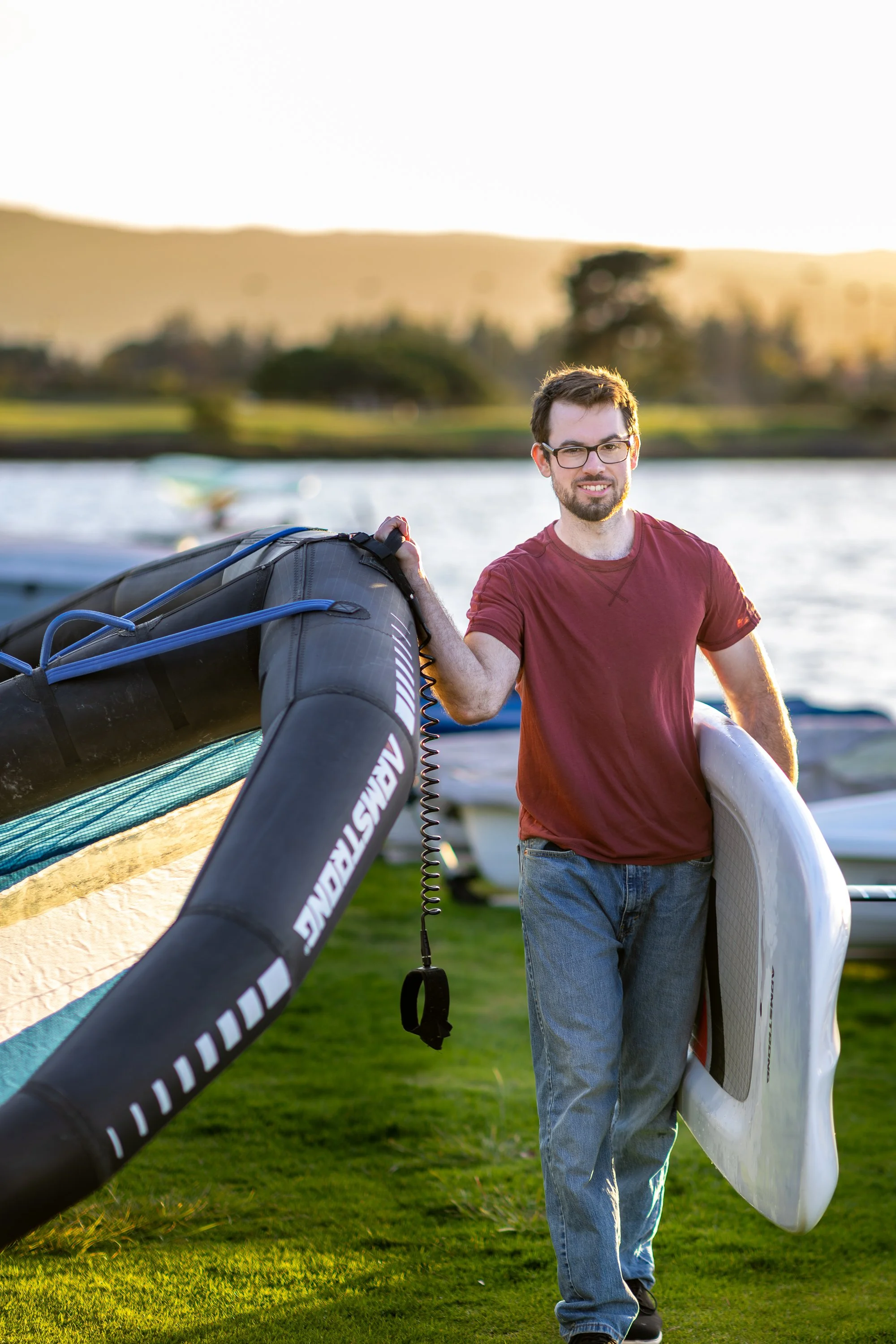
Walking in at golden hour.
Walking up from the water with the wing in one hand and the board under his arm. The low sun behind him puts a rim of light on his hair and arms. Without a caption, you know exactly who he is and what he's just been doing.
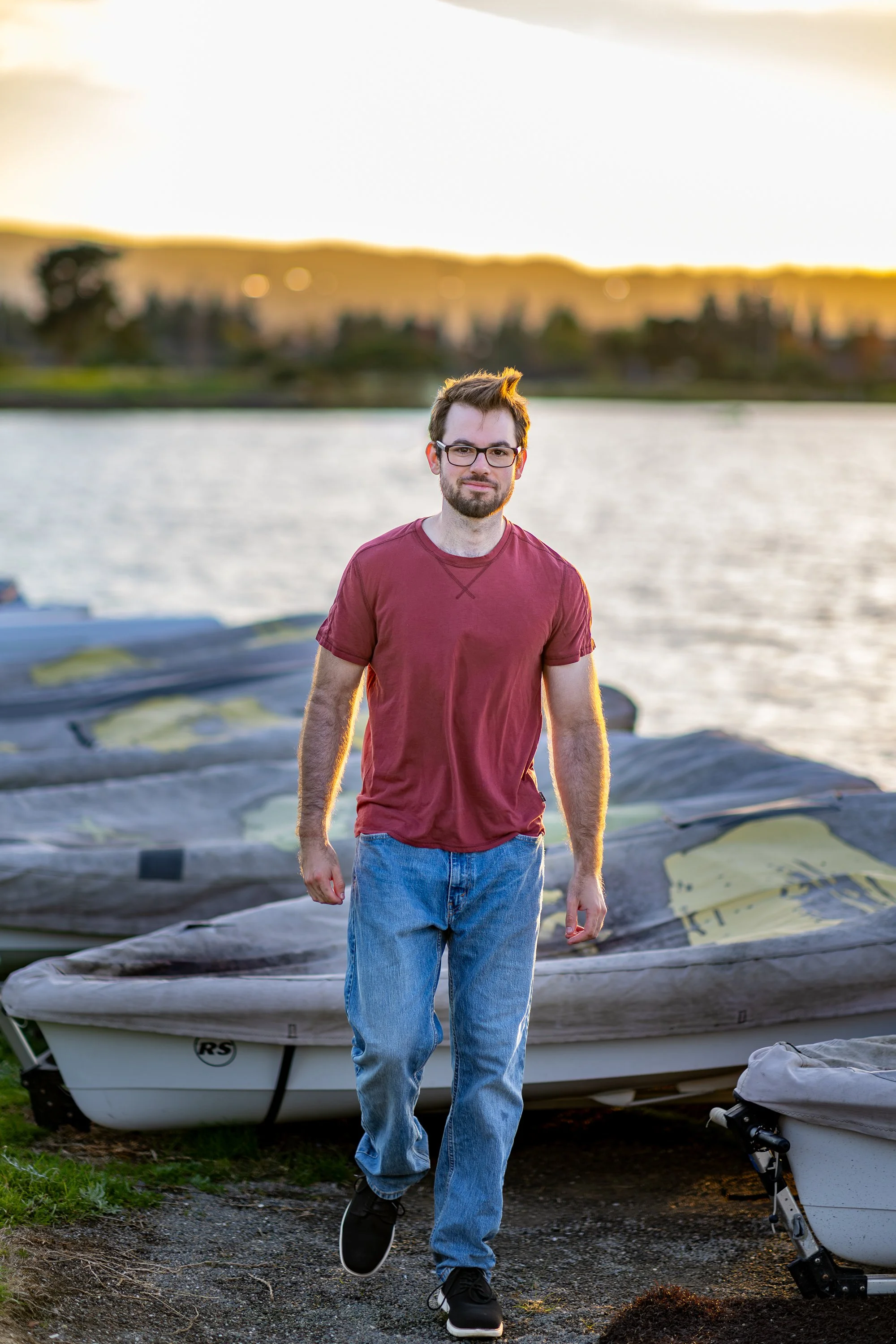
The dinghy lawn.
Walking between the covered dinghies on the lawn. The rows of boats give the frame depth and place it clearly at Shoreline.

Against the canopy.
A tighter portrait against the wing, with the colors of the canopy soft behind him.
The light at Shoreline in that last half hour before sunset is some of the best on the Peninsula. With the sun dropping toward the Santa Cruz Mountains, the backlight comes in low across the water. If you book a session here, that's the window I'll plan around.
Frequently asked questions
Can I hire a photographer for wingfoiling or windsurfing in the Bay Area? Yes. I'm Matthew Duncan, an outdoor and action sports photographer based in Mountain View. I photograph wingfoiling, windsurfing, sailing and paddle sports at Shoreline Lake, the Palo Alto Baylands and other spots around the Bay, from the shore or the jetty.
When is the best time to photograph wingfoiling at Shoreline Lake? Afternoons, when the breeze fills in off the Bay. Spring and summer are the most reliable. In fall and winter you need to watch the forecast and pick the day, as we did here. The rider needs at least 9 to 10 knots of wind to get up on the foil.
What lens do you need to photograph wingfoiling? A long telephoto. I used a 70-200mm f/2.8 and a 100-400mm. At 400mm, a rider 100 meters away fills about a third of the frame height. A high-resolution camera lets you crop further.
What shutter speed freezes wingfoiling action? 1/800 froze the rider and the board in my photos. For crisp spray, go faster: the sitting trick in this post was shot at 1/2500.
Where should a photographer stand to shoot a wingfoiler? Where the rider is reaching toward you at an angle, with the sun behind you or to your side. Agree on a turning mark beforehand so their jibes happen within range of your lens.
Is Shoreline Lake good for beginners? Yes. It's a 50-acre enclosed saltwater lake with flat water, and the boathouse offers lessons and rentals for wingfoiling, windsurfing, sailing, kayaking and stand-up paddleboarding.
Do you also photograph other outdoor sports? Yes. I've photographed cycling on 17 Mile Drive and an eight-day trek on the Patagonia O Circuit, and I'm a climbing instructor myself. If your sport happens outside, I'm interested.