
Luang Prabang rewards photographers who are willing to get up before the town does. The whole old peninsula is a UNESCO World Heritage site squeezed between the Mekong and the Nam Khan, and its two best subjects sit at opposite ends of the day: the alms ceremony at dawn, and Kuang Si Falls once the light softens under rain clouds. We had one full morning for the first and one wet afternoon for the second. Both delivered, for reasons that had nothing to do with good weather.
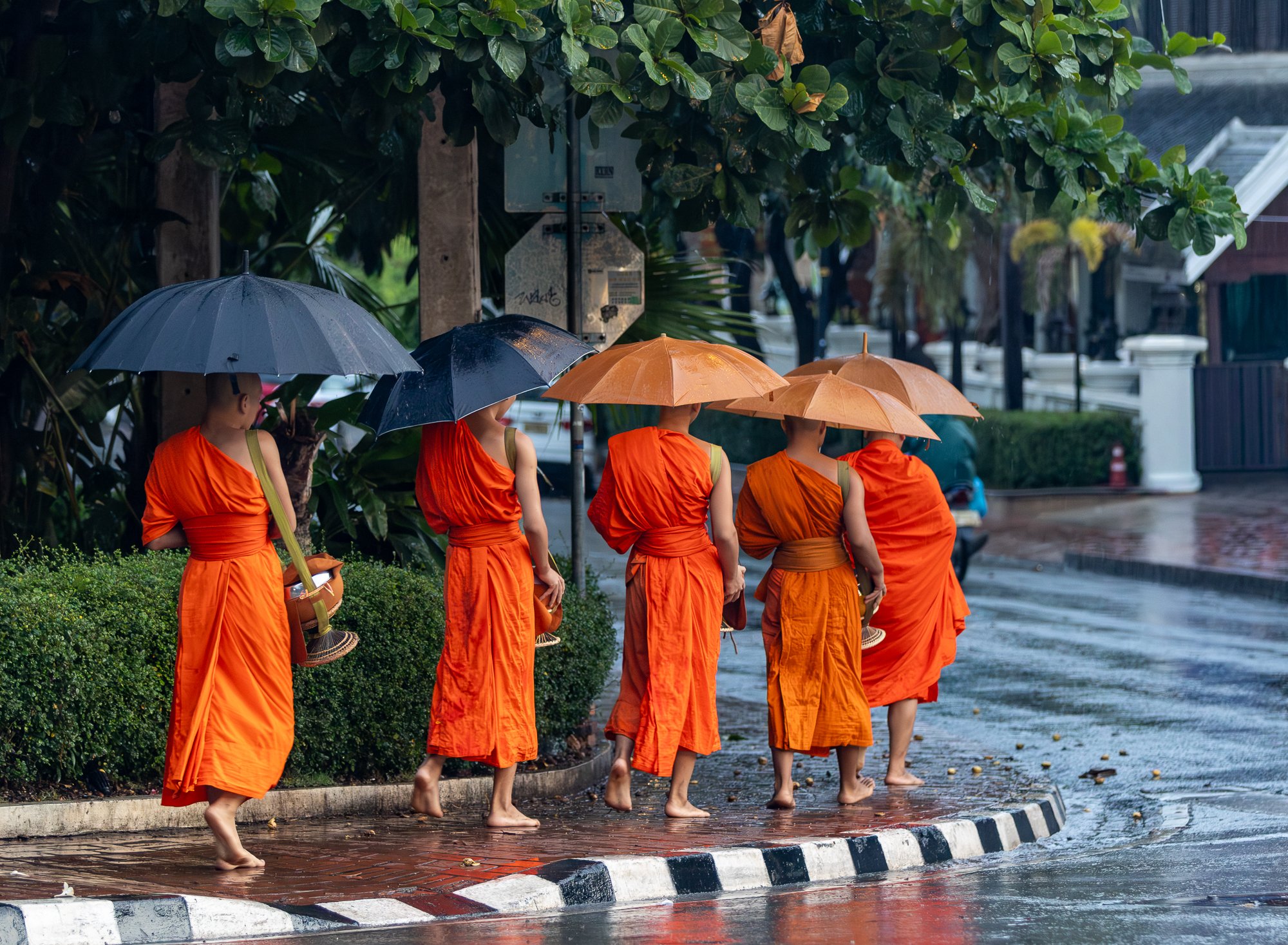
The first line came out of the grey before I had even set my footing.
What time does the alms ceremony start in Luang Prabang?
The monks leave their temples at first light, which in the wet season means roughly 5:30am. If you want a position before the procession reaches you, plan to be on the street by 5:15.
My alarm went off at five. It was raining, properly raining, and for a moment the bed made a strong argument. The walk from our guesthouse to the corner of Chaofa Ngum Road took ten minutes, one hand holding an umbrella, the other keeping the camera dry under my jacket. The street was silent except for water moving in the gutters. Then the first line of orange appeared out of the grey, and the whole soggy walk justified itself in about four seconds.
Tak Bat, the daily alms round, has happened here every morning for centuries. Monks and novices walk barefoot in single file while residents kneel at the kerb and place sticky rice in their bowls. It is a religious ceremony, not a performance, and that distinction should drive every decision you make with a camera.
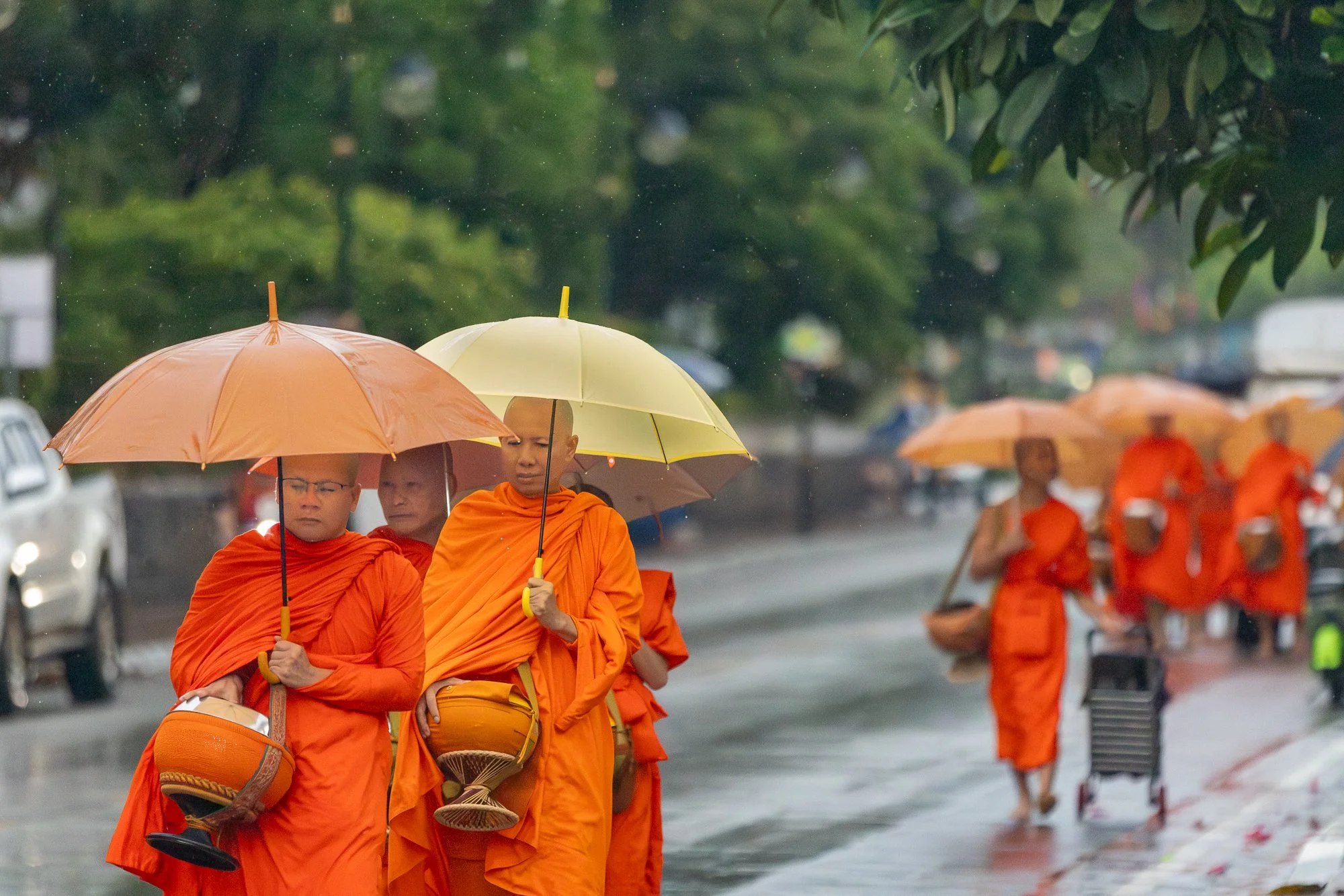
Compression from the 70-200 stacked the whole procession into three feet of frame.
How do you photograph the alms ceremony respectfully?
Shoot from across the street with a long lens, keep quiet, and never step into or break the line. That is the whole method.
Everything I kept from that morning came from one position on the far kerb with the EF 70-200mm f/2.8 on the R5 Mark II. The reach let me fill the frame from thirty feet away without a monk ever having to register my presence. No flash, obviously. Flash at 5:30am into the face of someone performing a religious rite is the fastest way to become the cautionary tale in someone else's blog post.
The distance did something else I had not fully anticipated: it made the photographs better. Compression stacked the umbrellas and robes into layers, and because nobody was reacting to a camera, every frame is simply the ceremony as it actually happens. The rain helped too. Wet pavement doubled every robe as a reflection, and the umbrellas, which I initially cursed, turned out to be the most photogenic thing on the street.
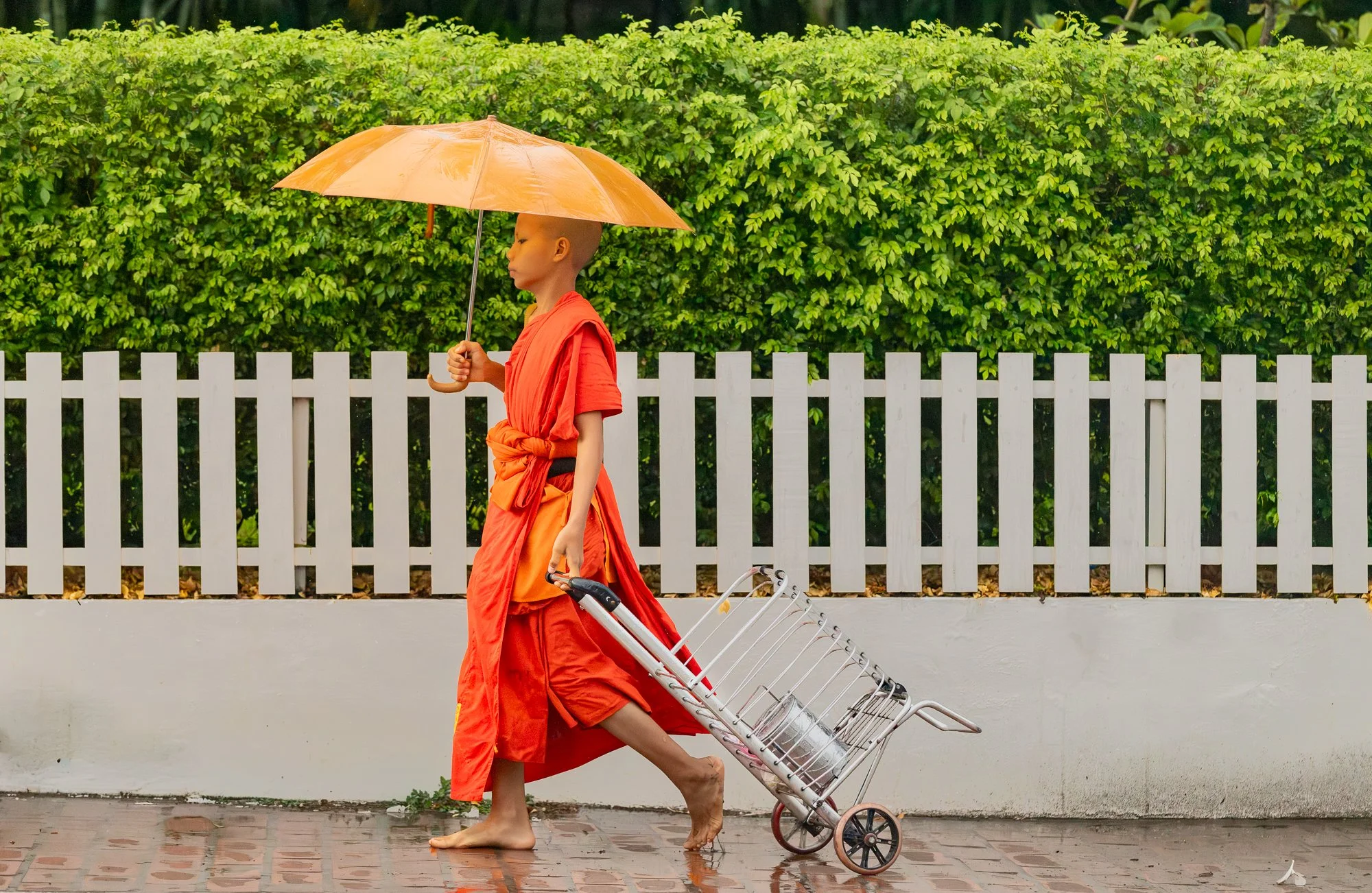
My favourite frame of the trip, and the least dramatic thing that happened all morning.
That picket fence frame is my favourite of the trip. A novice pulling a small trolley with his alms bowl, moving left to right past a white fence with a hedge above it. Nothing about it is dramatic. It works because the background is doing half the composition and he is doing the rest.
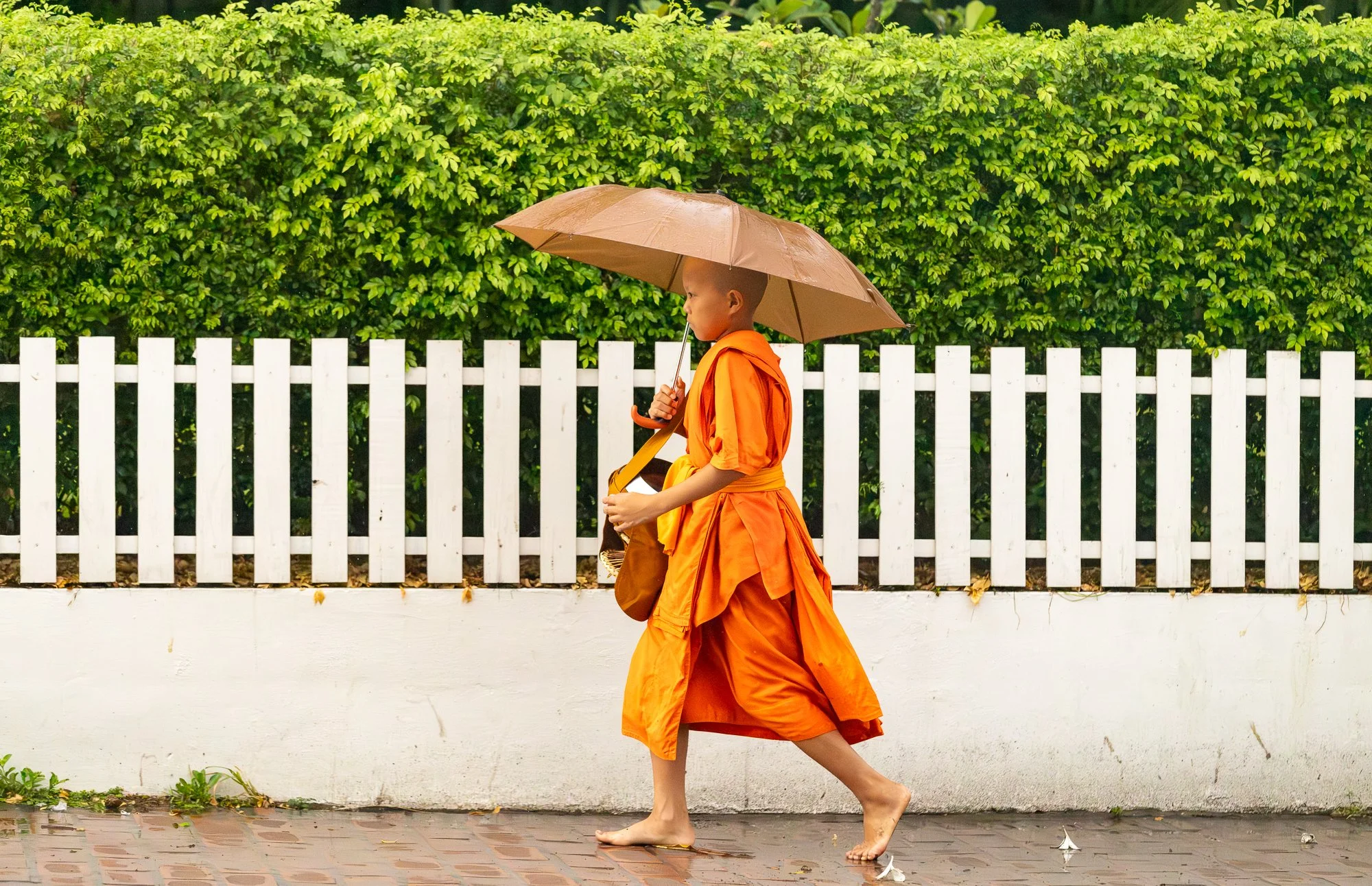
Same fence, two minutes later. The backdrop did half the work all morning.
What actually happens during the ceremony?
A local woman had set out a row of small red plastic stools at the kerb near my corner, and just before the procession arrived she flagged down two young women who were hurrying up the street with baskets of offerings. They were late. She got them seated with about thirty seconds to spare, then stood in the road facilitating the whole exchange, taking photos on her phone and passing food across as each monk went by.
When she redirected the head of the line toward the seated pair, the lead monk paused. There was a beat where the whole procession compressed behind him like a slinky. Then he adjusted, the line bent toward the stools, and each monk in turn received an offering before the file straightened out and carried on into the rain. The entire negotiation happened without a word that I could hear.
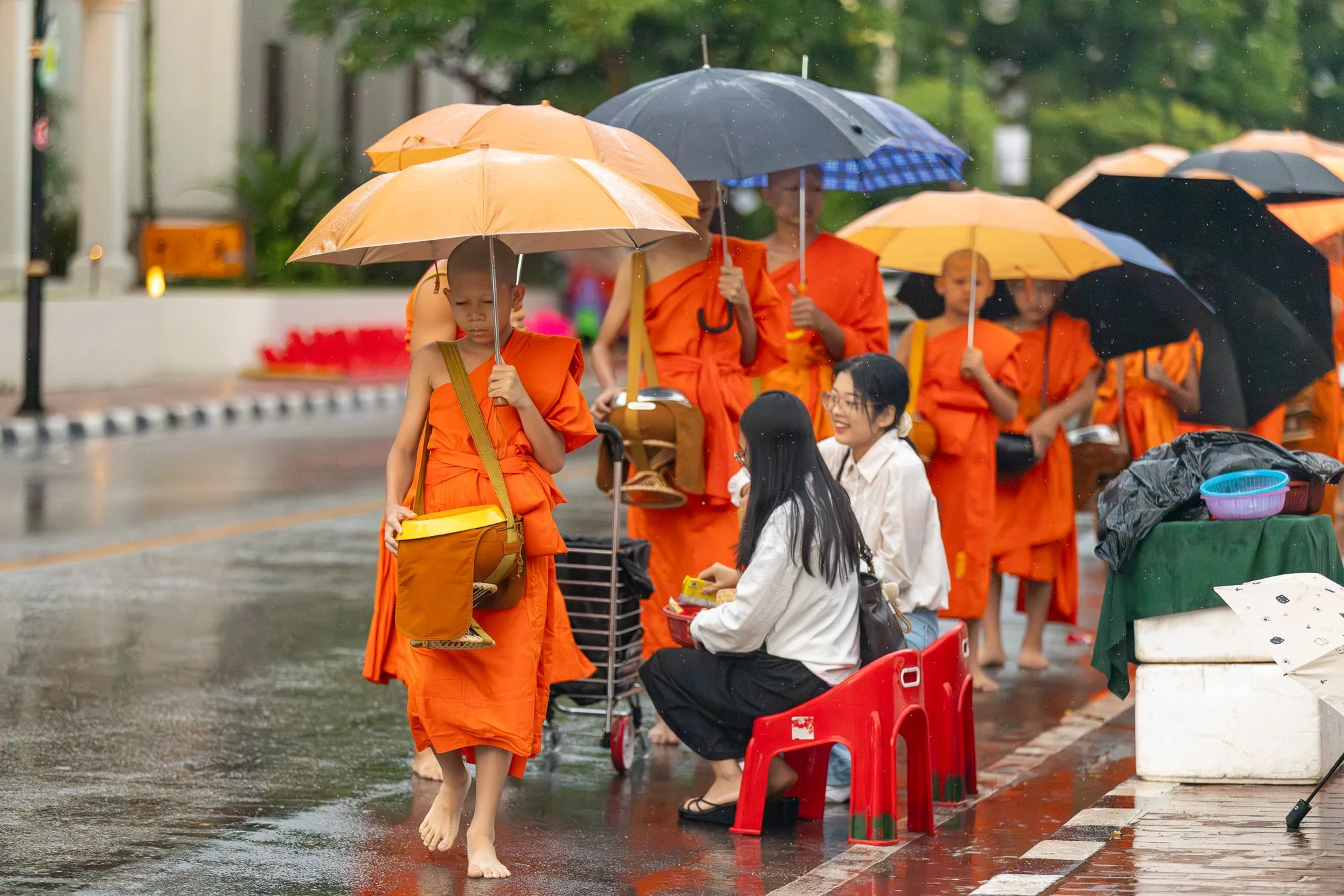
The entire negotiation happened without a word I could hear.
Watching it taught me more about the ceremony than any guide would have. This is a living exchange between the town and its temples. Residents feed the monks; the act of giving is the point. Tourists are tolerated at the edges, and the polite place to stand is exactly there, at the edge.
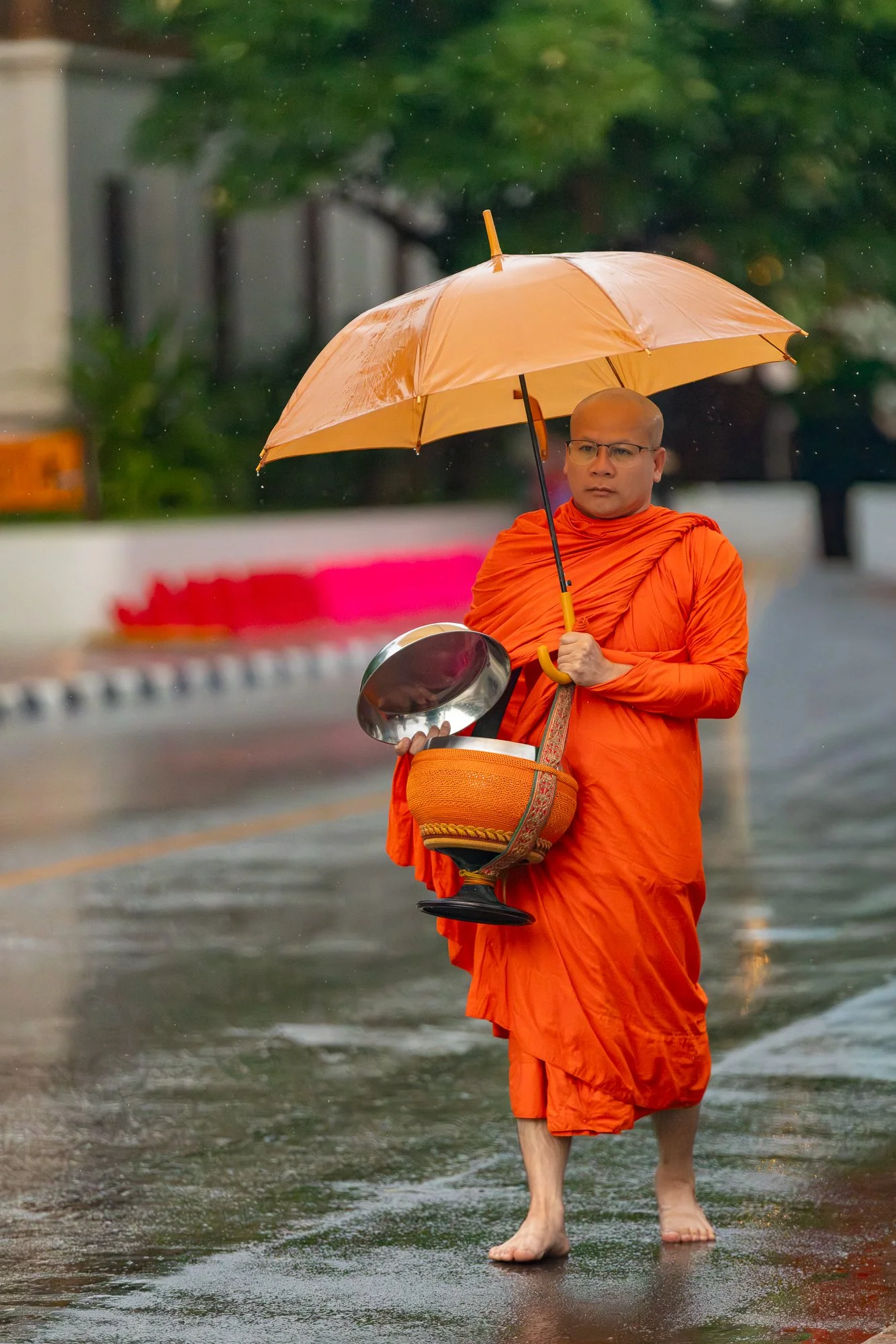
Thirty feet away and completely unaware of me, which is exactly how it should work.
What camera settings work at 5:30am in the rain?
High ISO, wide aperture, and a shutter speed fast enough to freeze a walking pace. Accept the noise and fix it later.
Rain plus pre-dawn cloud cover meant I was shooting at f/2.8 and still pushing ISO well past 6400 to hold 1/320 of a second. Ten years ago those files would have been unusable. Now the workflow is one step: AI Denoise in Lightroom Classic, applied to the original raw files and batched across the whole take before I even started culling. The noise simply is not part of the conversation any more, which changes what a dark rainy morning is worth photographing.
One practical note: bring a way to shoot one-handed. Between the umbrella and the camera I had no free hands for the entire ceremony, and image stabilisation on the 70-200 earned its keep.
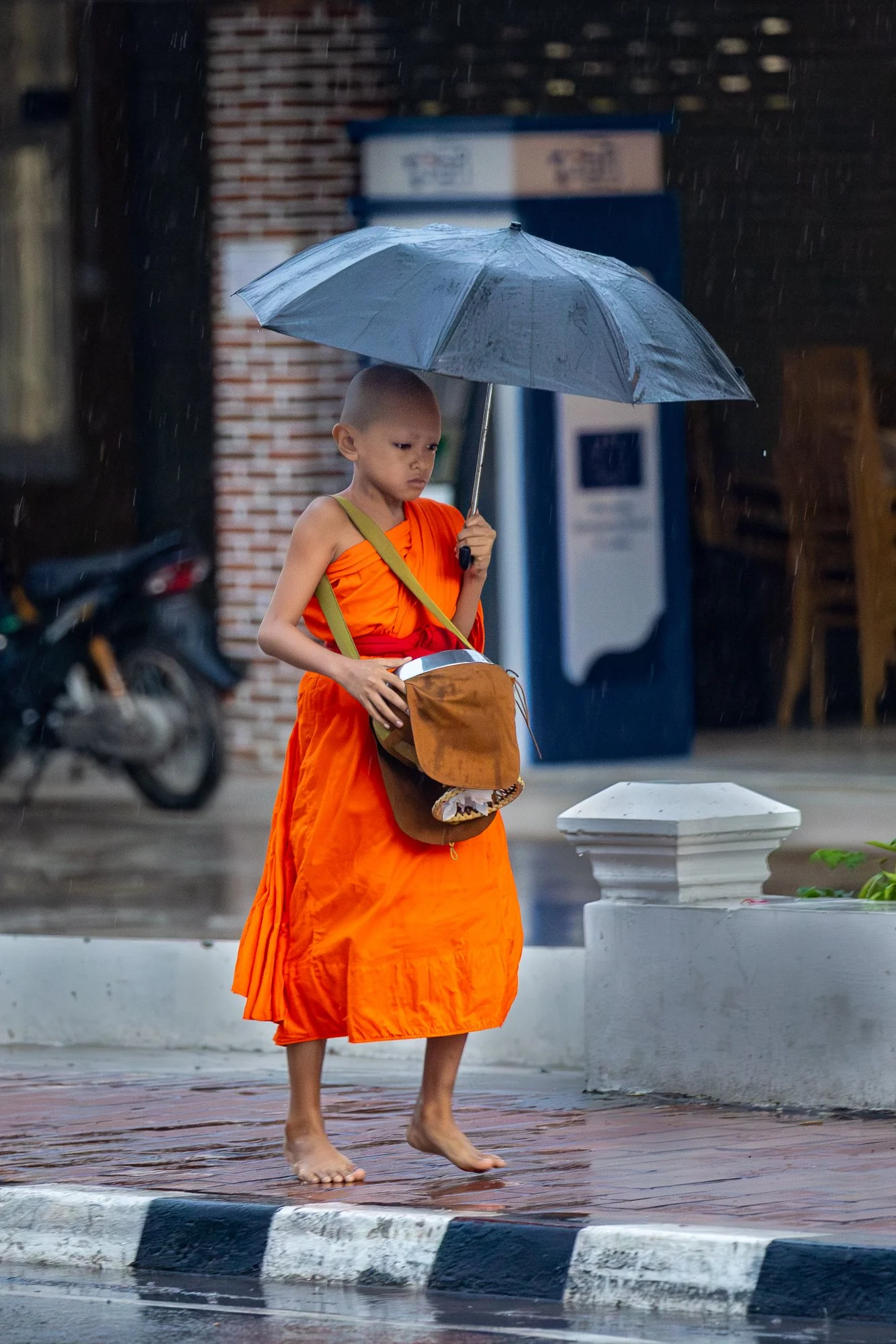
Thirty feet away and completely unaware of me, which is exactly how it should work.
Is Kuang Si Falls worth visiting in the rainy season?
Yes. Go anyway, and go because of the rain rather than despite it.
Kuang Si sits about 45 minutes south of the old town. The travertine pools that make the place famous hold their turquoise colour through light wet-season rain, and the crowds that mob the boardwalks in the dry months thin out dramatically when the sky opens. We arrived in a steady drizzle and had lower pools nearly to ourselves, with raindrops stippling the surface of water the colour of oxidised copper.
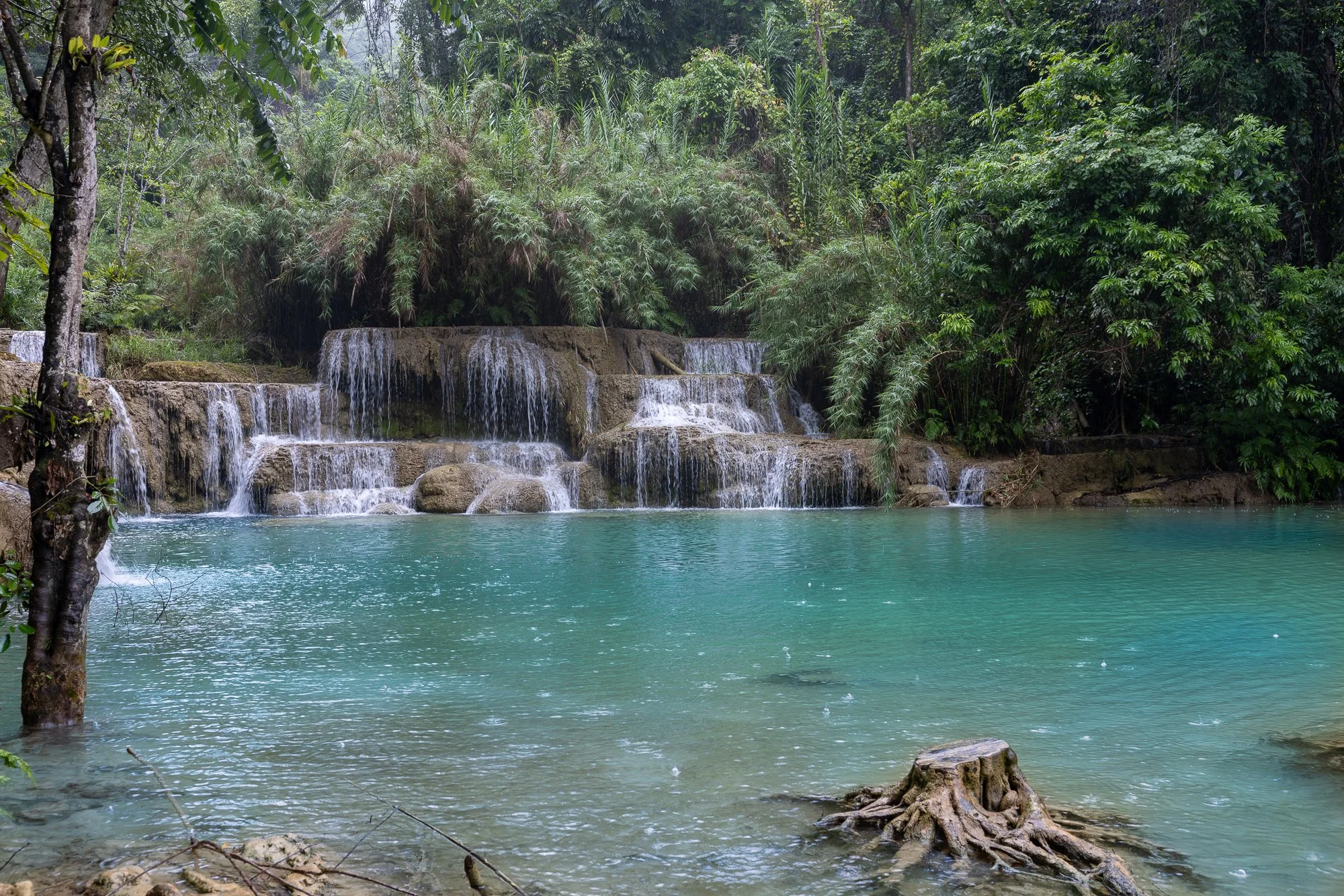
Rain on the pool and almost nobody on the boardwalk. The trade was worth it.
The main falls at the top of the trail drop in a wide tiered cascade over limestone that looks poured rather than eroded. Under overcast light the whole scene sits within one exposure, no filters and no bracketing, which is the quiet advantage of bad weather at waterfalls: the dynamic range problem solves itself.
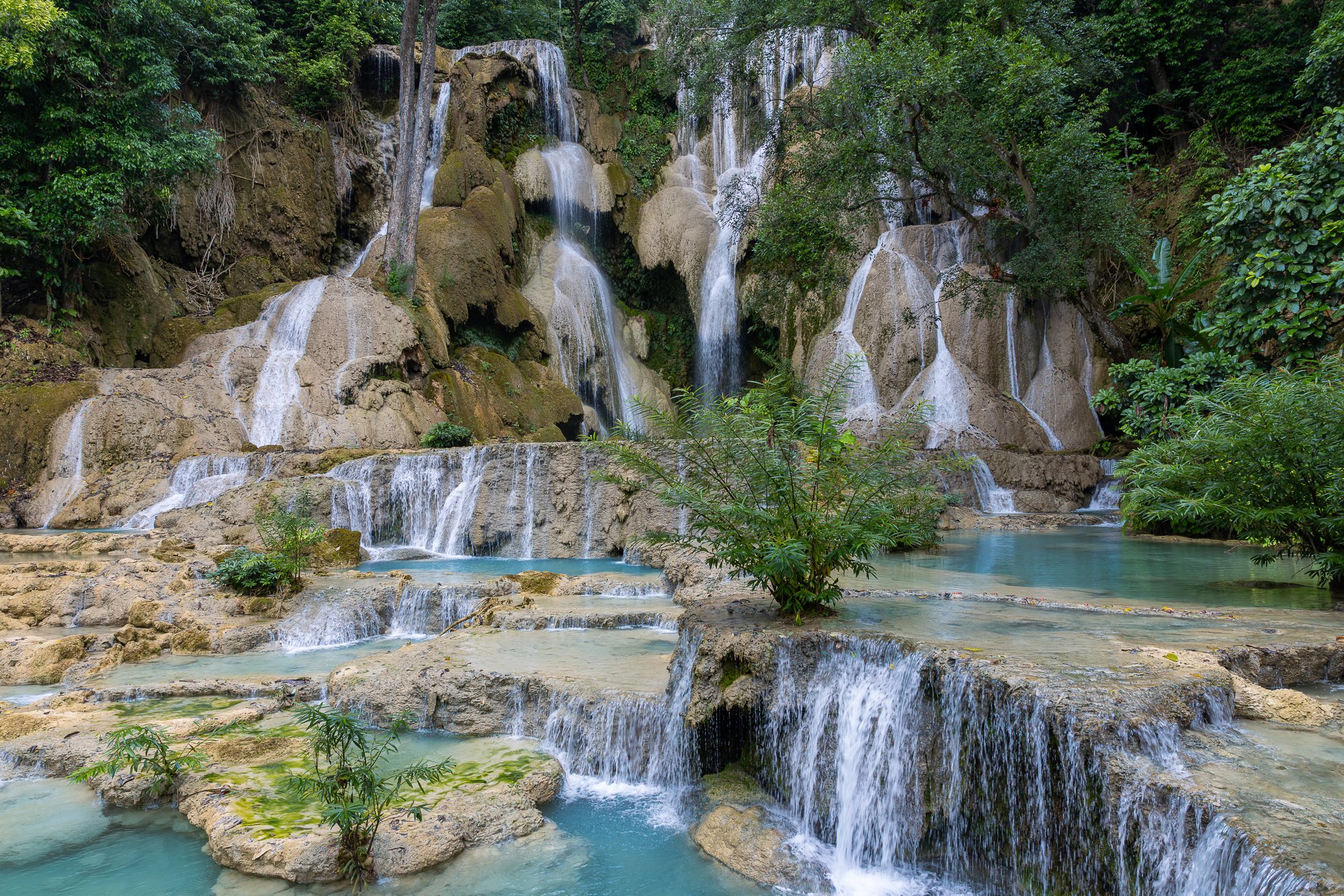
Overcast light put the whole falls inside one exposure. No filters, no bracketing.
There is an entrance fee at the gate, payable in kip, so carry cash. Shared songthaews run from the old town all morning and will wait while you shoot. If a clear day is on offer, take the rain instead. The color holds, the people leave, and travertine photographs better wet.
The same logic ran through the whole Luang Prabang stop, honestly. Every condition that looked like a problem from inside the guesthouse turned out to be the reason the photographs worked. It is the same lesson the Patagonia O Circuit kept teaching me in a colder register, and the same one I lean on when a family session draws a grey Bay Area sky: flat light and weather are not the enemy of a photograph. Indifference is.
Frequently Asked Questions
Where is the best place to watch the alms ceremony in Luang Prabang?
Sisavangvong Road through the temple district has the longest processions and the biggest crowds. A quieter side street such as Chaofa Ngum Road gives you more space, fewer tour groups, and monks who are not running a gauntlet of phones. The ceremony passes through most of the old peninsula, so any street near a temple works.
Can tourists photograph the monks during Tak Bat?
Yes, from a respectful distance. Stay across the street, use a longer lens, never use flash, and never block or break the procession line. Dress as you would to enter a temple, with shoulders and knees covered.
Should tourists participate in the alms giving?
Only if the act is meaningful to you and done properly. Buy sticky rice from the morning market beforehand rather than from street vendors along the route, kneel at the kerb as residents do, and give in silence. If you are there primarily to photograph, the more respectful choice is to stay on the far side of the street.
How long does the alms ceremony last?
Roughly 30 to 45 minutes from the first procession to the last. Individual lines pass any given point in a few minutes, with gaps between temples, so an early position rewards patience.
How do you get to Kuang Si Falls from Luang Prabang?
Shared songthaews leave from the old town throughout the morning and take about 45 minutes each way. Arrange the return time with your driver before you walk in. There is a modest entrance fee at the gate, payable in cash.