
An Editorial Session at the Pulgas Water Temple, Woodside
The Pulgas Water Temple is one of the most striking pieces of architecture in the entire Bay Area, and almost nobody on the Peninsula has been there.
That's not an exaggeration. I've asked. Most of my clients, born and raised in the Bay Area, have never heard of it. The few who have heard of it usually haven't visited. It sits about ten minutes south of Filoli on Cañada Road, above the southern end of Crystal Springs Reservoir — a Greek-revival domed rotunda with twelve fluted Corinthian columns, a 175-foot reflecting pool, and twin allées of Italian cypresses flanking it on either side. It was built in 1934 by the San Francisco Public Utilities Commission to mark the terminus of the Hetch Hetchy aqueduct — the engineering project that brought drinking water from Yosemite National Park to the Bay Area, 167 miles by gravity.
There's an inscription carved around the rotunda's frieze, in Latin and English: "I give waters in the wilderness, and rivers in the desert, to give drink to my people." The line is from the Book of Isaiah, chapter 43. It's the only piece of biblical text I know of carved into a piece of San Francisco public infrastructure.
This was the third location in a one-day session with Avalon. The first stop was Filoli's gardens, shot in colour for a commercial brief. The second was Filoli's interior, shot in black and white as editorial. Pulgas was always going to close the day. The brief shifted again here — looser, more atmospheric, less about delivering a tight commercial set and more about making one or two genuinely memorable frames in a location that demanded its own approach.
This is what shooting that looks like.
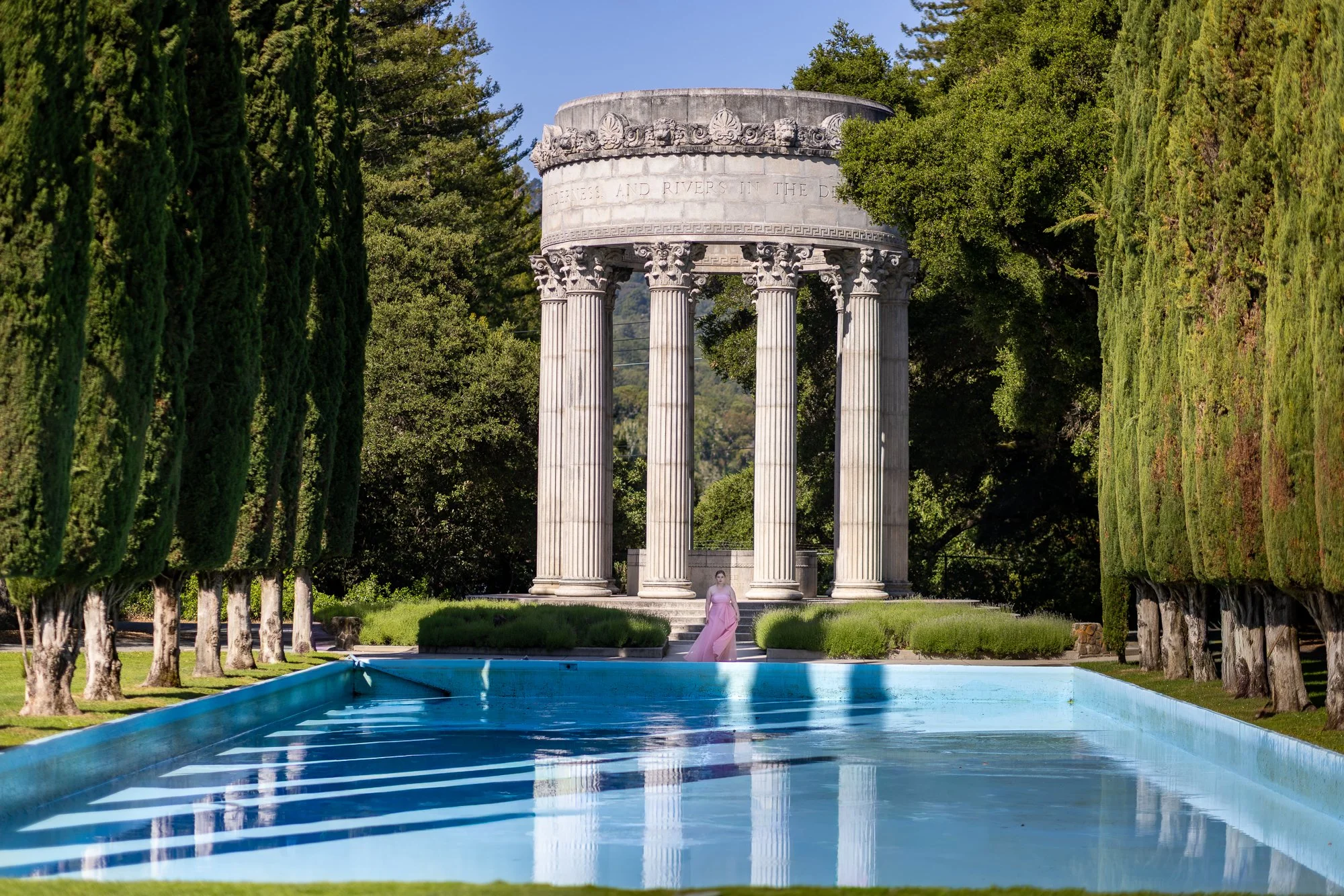
The establishing shot — the architecture was designed to be photographed from this exact spot.
The first frame at Pulgas is always going to be the establishing shot.
You stand at the far end of the reflecting pool, the camera on the centreline, the rotunda framed perfectly between the cypress allées on either side. The pool runs the full distance to the steps of the temple. The columns reflect in the water. The cypresses hold the frame on both sides. There is no version of this composition that doesn't work — the architecture was designed to be photographed from this exact spot.
What you do with the subject inside the frame is the only variable.
I positioned the model at the foot of the temple steps, small enough to read as scale rather than subject. The pink dress in this frame is a colour note, nothing more — a single point of warmth in an otherwise cool palette of grey stone, dark cypresses, and the strange artificial blue of the chlorinated reflecting pool. Shot on the 35–70 at 35mm, exposed for the rotunda highlights, focused on the columns rather than the subject. The subject is sharp anyway because at this distance everything is.
This is the frame that goes on a magazine cover or a gallery wall. Not because of the subject — because of what the subject means at that scale, inside that architecture, in that light.
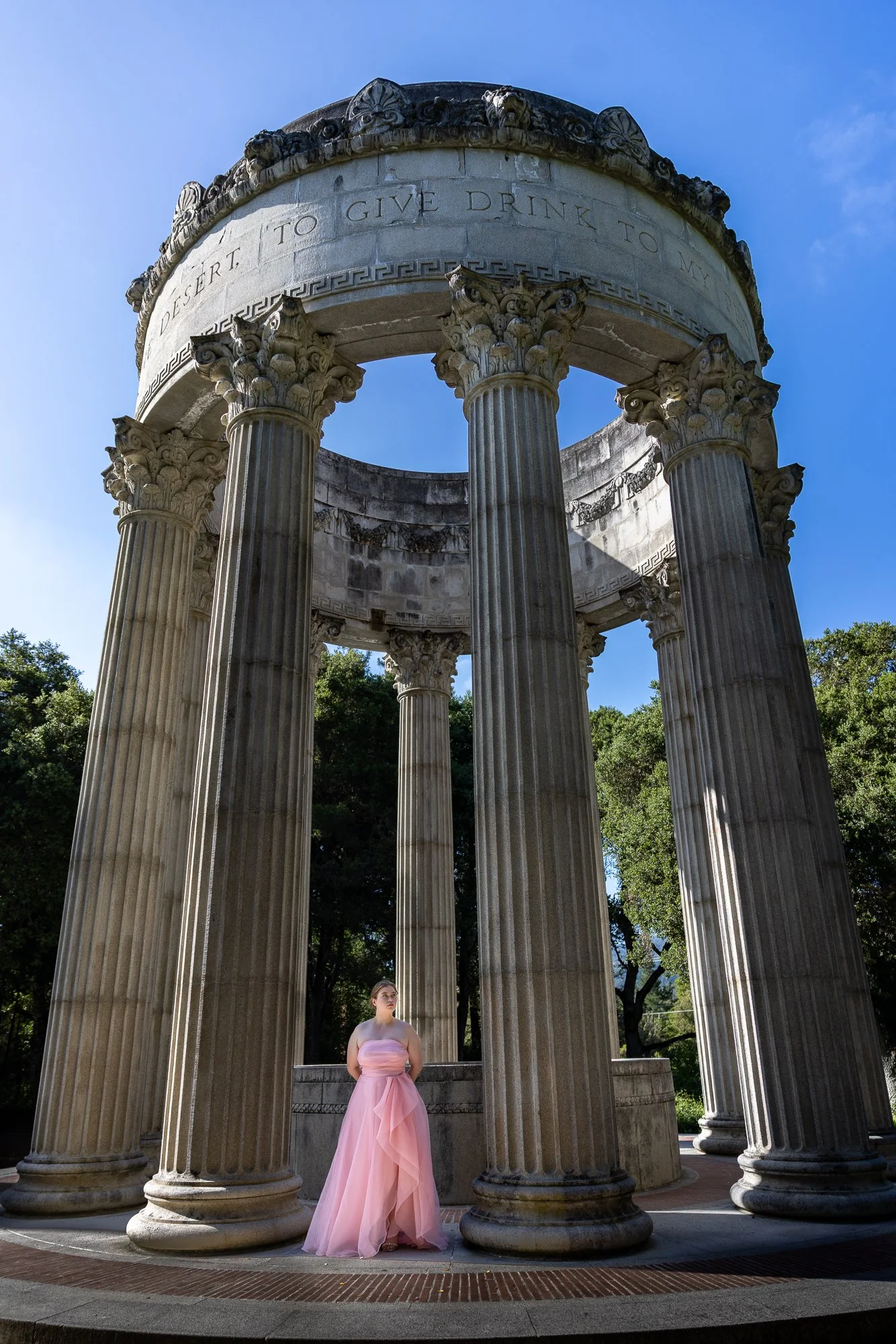
Looking up from beneath the dome — the lean of the columns toward the centre concentrates the eye on the subject.
The second frame is the inverse.
Walk under the rotunda. Stand near the centre of the dome. Look up. The columns rise on every side, the carved frieze with the Isaiah inscription circles overhead, and the open sky shows through the gaps between the columns. Now place the model centred under the dome and tilt the camera back to capture the architecture above her.
This is the frame most photographers don't take, because it requires a wide-angle lens and a willingness to point the camera at the sky in midday sun. The lens distortion at the edges of a 16mm frame is real. The columns lean inward. The dome flattens. Most people see that as a problem to correct in post.
I see it as the point of the frame.
The lean of the columns toward the centre concentrates the eye on the subject. The flattened dome reads as halo, not architecture. The inscription overhead provides context — waters in the wilderness, rivers in the desert — without being the subject. The dress is a single warm colour at the centre of a cold-toned environmental composition.
Shot on the 16–35 at 16mm, looking up, exposing for the inscription overhead so the model fell slightly into shadow. The fall-off makes her read as inhabiting the architecture rather than placed in front of it.
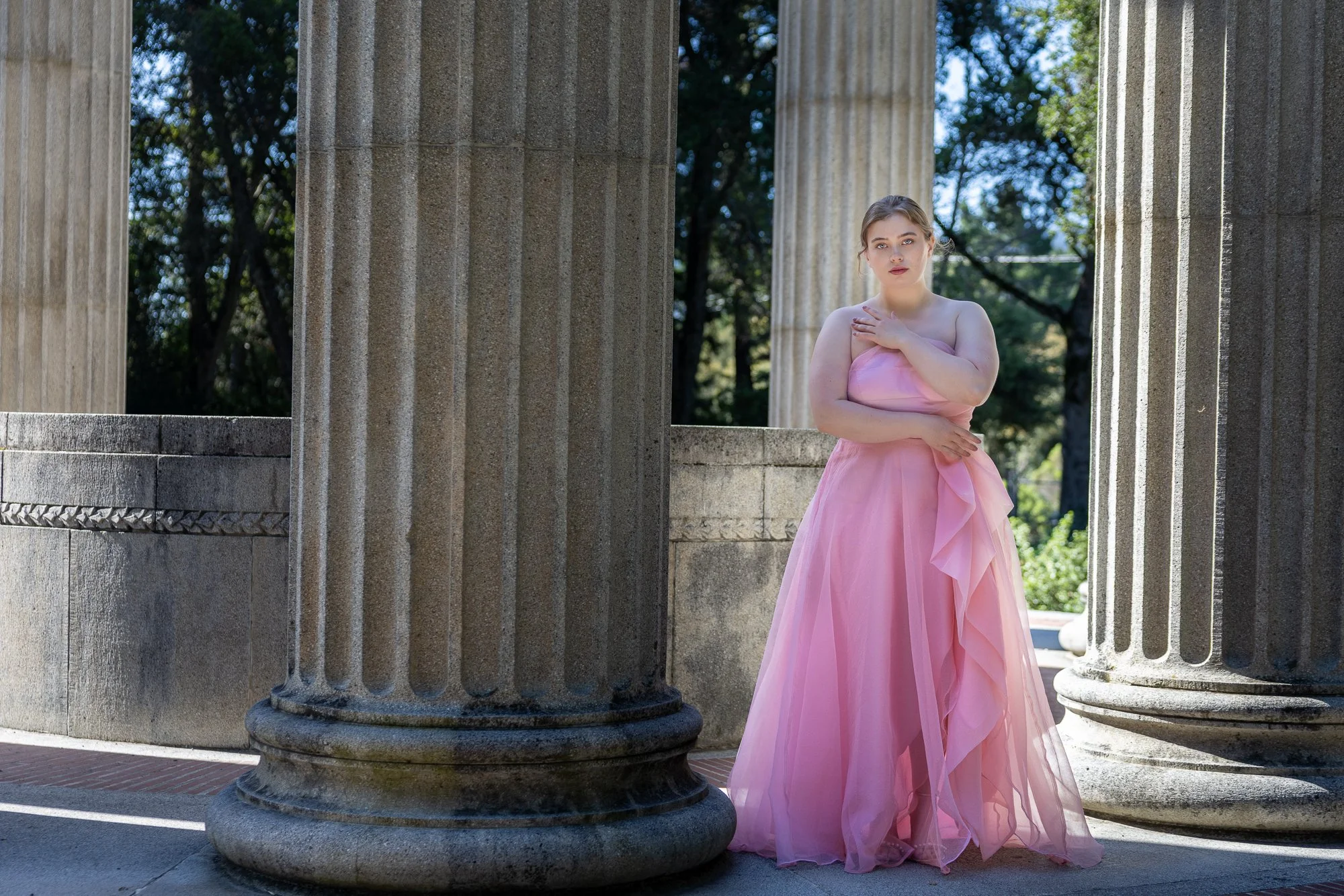
The breath frame — after the architectural compositions, the reminder that the whole thing was built around a person.
The third frame breaks the architecture entirely.
After the wide and the wide-vertical, the post needs a beat of stillness. A close portrait. The architecture reduced to texture behind the face. The session resolved into a single image of a person, not a person inside a place.
I positioned the model just inside the colonnade, hand pressed flat against one of the fluted columns, weight slightly into the stone. Shot on the 85mm at f/1.4, focused on the eye nearest the camera. The column behind her goes to soft grey bokeh. The fluting becomes vertical lines of texture. The face holds the frame.
This is the frame that humanises the location. After the architectural compositions, after the geometric establishing shots, after the wide-angle reach upward — this is the breath. The reminder that the entire composition was built around a person.
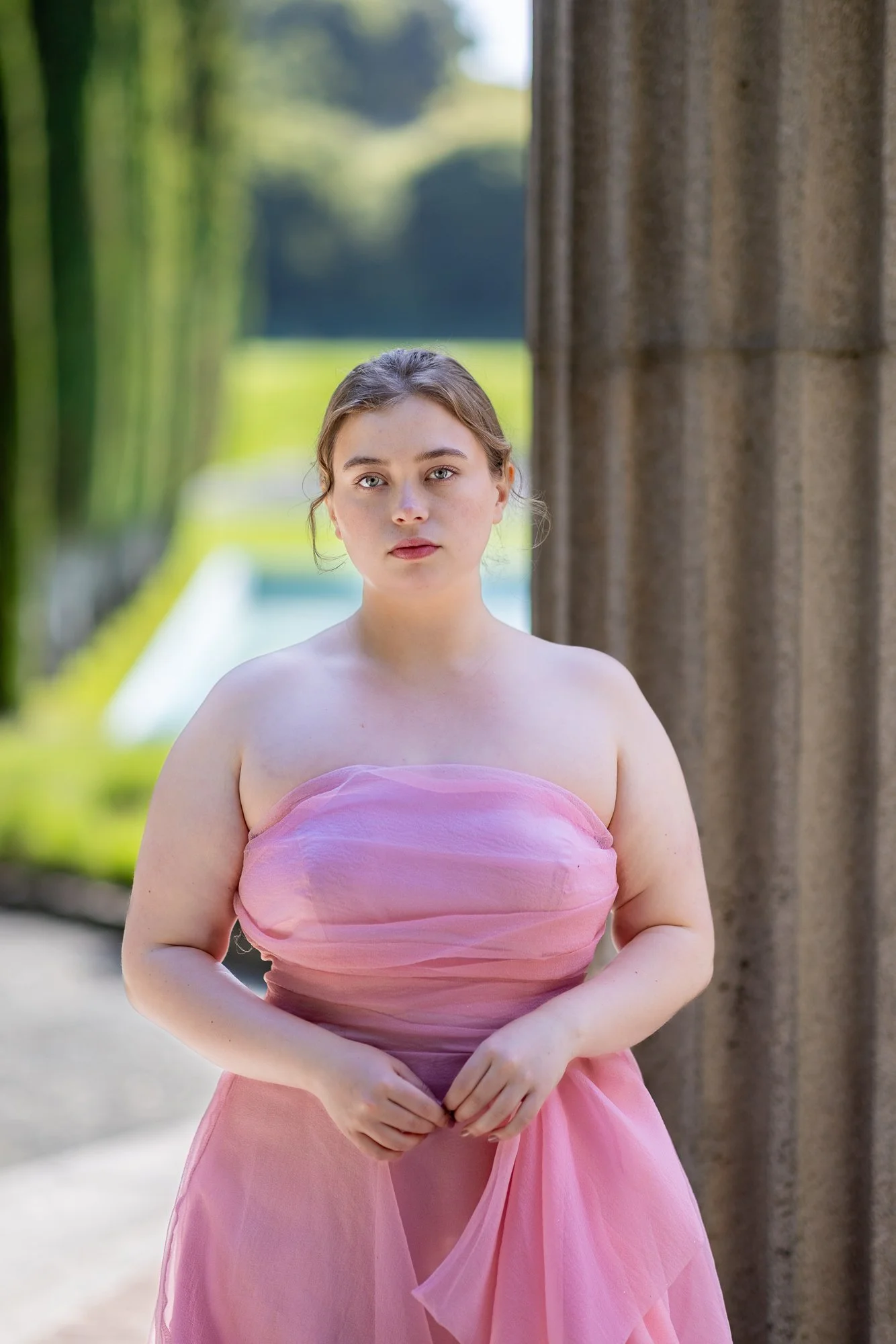
The two columns become a doorway. The cypresses recede behind in converging lines. The dress fills the frame.
The fourth frame compresses everything.
Step back from the temple, into the cypress allée. Find a position where two of the rotunda's columns frame the model, and the cypress allée recedes behind her in long converging lines. Shoot on the 70–200 at around 100mm — that focal length flattens the perspective and makes the cypresses appear to stack, layer behind layer, into a green tunnel. The two columns become a doorway. The dress fills the doorway.
This is the most cinematic frame of the day. The composition is doing classic editorial work — strong vertical framing devices on both sides, deep recession in the centre, the subject placed at the convergence point of all the visual lines. It reads like a still from a film that hasn't been made.
The light at this point in the afternoon was harsh and directional, but the columns provided shade on the model's face while the cypresses behind held their colour against the bright sky. That kind of micro-environment within a location — pockets of usable light inside otherwise impossible conditions — is most of what experienced location photography actually is. You're not finding good light. You're finding the one place the good light exists, and putting the subject inside it.
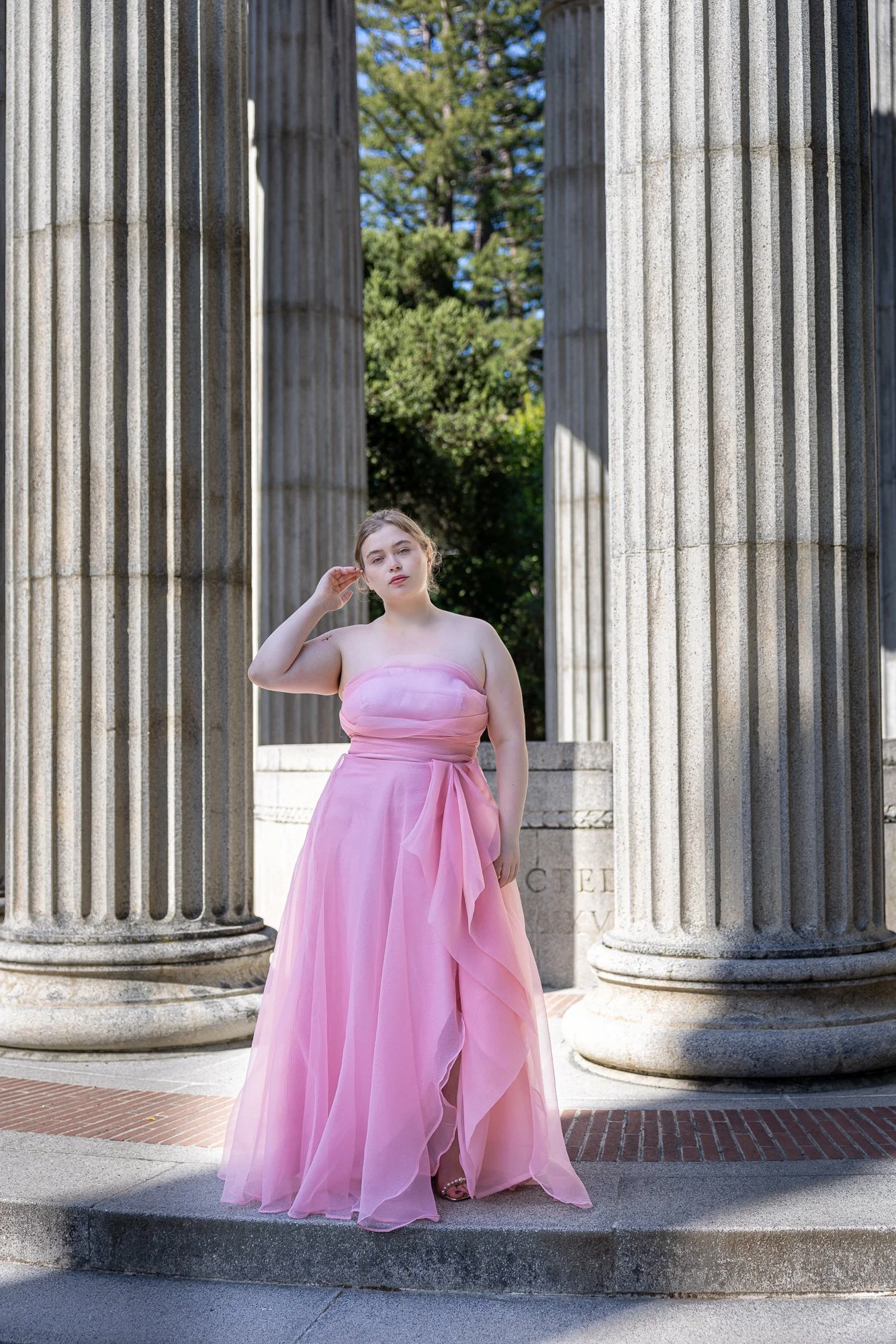
The closing frame — the session itself, made on this day, between these people, in this place.
The closing frame is movement.
By this point Avalon and I had been working for most of the day — Filoli gardens in the morning, Filoli interior through midday, the drive south to Pulgas, the establishing shots, the architectural frames, the close portraits. The session was almost done. The light was warming toward late afternoon. We had every frame we needed.
So the last frame is for energy. Walking through the columns, holding the dress out so the chiffon catches the light, the fabric moving behind her. Servo autofocus tracking the eyes. 1/800 shutter to freeze the dress mid-motion. The columns on either side become motion-blur abstracts. The subject stays sharp.
This frame doesn't sell the dress, doesn't sell the location, doesn't sell the model individually. What it sells is the session itself — the idea that something was made here, on this day, between these people, in this place. That's the frame I'd put at the end of the gallery delivery and the closing image of any portfolio piece built from this session.
What Pulgas Is
Pulgas is hard to describe to people who haven't been. It's not a public park in the conventional sense — it's SFPUC land, open to visitors during specific weekend hours when the gates are unlocked. There are no guides, no signs explaining what you're looking at, no concessions. The grounds are quiet. The reflecting pool is sometimes drained for maintenance. The cypresses smell like Tuscany and the pavement underneath the rotunda is hot in summer.
If you go, go in the morning before the light gets harsh, or in the late afternoon when the cypresses cast long shadows across the pool. Bring water, because there isn't any for sale on site. Read the inscription if you're tall enough to make it out from the ground — the Latin is on one side, the English on the other.
Sessions like this one aren't the standard work I do — most of what I shoot is personal lifestyle and family adventure across the Bay Area, with the occasional commercial or editorial brief layered in when a model and a concept align. But Pulgas, when the conditions and the subject and the brief all line up, is one of the locations on the Peninsula I'd most want to keep coming back to.
This is the third of three posts from a single day with Avalon. The first was at Filoli's formal gardens. The second was inside Filoli's historic house, in monochrome. Each post stands alone — different location, different brief, different visual register — but the three together describe what a full editorial day with a signed model actually looks like.
You can see more locations like this in my guide to the best Bay Area outdoor photography locations, or get in touch to talk about your own session.
*** Model: Avalon Butler — represented by The Dreamers Management ***